Tensions, Conflicts, And A Progressive Viewpoint
In the wake of the Korean and Vietnam Wars, the Nixon Administration, and a general atmosphere of governmental distrust, television was gathering the courage to be more progressive, more critical, and more defiant of the standards. The early 1970s saw a boom of film and television that carried a social or political edge, and M*A*S*H was just one of the shows at the forefront.
M*A*S*H had a burning desire to address social issues and tackle contemporary American society, which should have been challenging since the show took place two decades in the past and halfway around the world. Though they achieved their goal, their methods were sometimes unconventional.
One theme that initially remained underdeveloped in early seasons was feminism in the army. The only women in the 4077th MASH are the nurses who, despite their invaluable skill displayed in the operating room, began the show as period-typical objects of male affection.
When developing the show, Gelbart and Reynolds had interviewed women who were nurses in Korea, as well as surgeons and other veterans, to better portray their experiences. An interview with former army nurse Pam Blalock revealed MASH nurses were revered by their fellow camp members, thought to be invaluable. When they weren’t assisting in surgery or looking after patients in the post-op ward, they would spend their few free hours caring for local Korean orphans, but it was also common for them to meet and promptly marry officers who passed through.
The 4077th’s head nurse, Major Margaret “Hot Lips” Houlihan, spent the early seasons as a hotheaded, shrill army brat whose days were defined by her extramarital affair with her fellow major, Frank Burns. Following Frank’s departure from the show, Margaret was able to grow as a character, and after her marriage to and subsequent divorce from a lieutenant colonel midway through the show, she was able to grow as an independent woman and nurse.
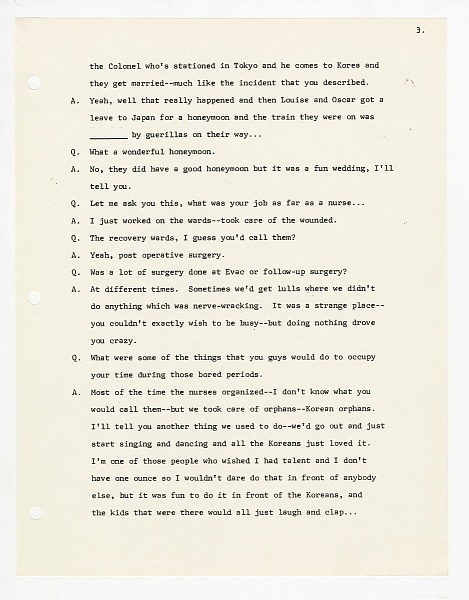
A page from the transcript of the interview with Pam Blalock
In the season seven episode, “Hot Lips Is Back In Town,” a newly single, euphoric Margaret funnels her energy into overhauling the camp’s triage process, emphasizing her military knowledge and regrounding her role as an officer.
By the end of the series, Margaret and the other nurses had seen numerous female-centric storylines, allowing them to be more fleshed out as characters.

Gold headdress worn by Klinger
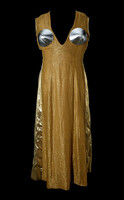
Gold dress worn by Klinger
One theme lightly addressed over the course of the show was homosexuality and queerness. They were most prominently incorporated as a joke, through the running gag of Corporal Klinger, the draftee who spent the majority of the series wearing civilian women’s clothing in an attempt to receive a “section 8,” an official document declaring him mentally unfit to serve in the army.
Ironically, Klinger began to genuinely enjoy donning women’s clothing, understanding fashion and couture, learning how to sew his own pieces, and even once getting a rash when forced to wear his regulation army uniform.
These themes were occasionally addressed in seriousness as well, like in the season two episode “George,” which sees an army private confide in Hawkeye about being beaten by men in his unit for being gay.
When Frank hears a rumor that they have a gay soldier in the camp, he expresses his disgust and claims he just wants everyone to be normal, causing Hawkeye to pose the age-old question of “What’s normal?”
Hawkeye and Trapper eventually resort to blackmailing Frank to stop him from having the private dishonorably discharged.
Perhaps the most prominent and overarching theme on the show was the state of the mental health of soldiers, patients, and doctors alike. One of the most beloved characters who was not billed as a series regular was Allan Arbus’s Dr. Sidney Freedman, an army major and military psychiatrist who only appeared in 12 episodes during the run of the show. Sidney was introduced when Frank and Margaret demanded a psychiatric evaluation of the effeminately-clothed Klinger, and though Sidney did not indulge Klinger’s begging for a psychiatric discharge, he also did not side with the majors’ conservative views.
Sidney would then go on to help many patients during his appearances, including a soldier with trauma-induced amnesia, a soldier who claimed to be Jesus Christ, and several members of the 4077th. He was arguably the most grounded in reality of any recurring character, and he often cited his visits to the 4077th MASH as a welcome reprieve from the monotony of his army duties, even occasionally stopping by just to join their regular poker games.
In season five, Sidney was granted a “Letter Home” episode, something typically attributed to main characters. The episode, titled “Dear Sigmund,” sees Sidney write a cathartic letter to the deceased Sigmund Freud as he grapples with the recent suicide of one of his patients.
Ultimately, Dr. Sidney Freedman played a crucial role in the portrayal of mental health on M*A*S*H, and his calming, down-to-earth presence combined with a dry wit allowed viewers to conflate psychiatric treatment with a gentle, truly human character.