The History of the 4077th MASH
As iconic as M*A*S*H has become, the show did not start from scratch. A semi-autobiographical novel titled M*A*S*H: A Novel About Three Army Doctors was published in 1968 by the author Richard Hooker, a pen name for H. Richard Hornberger. Using his experience as a former military surgeon during the Korean War, Hornberger told the story of characters Captain Benjamin Franklin “Hawkeye” Pierce, Captain “Trapper” John McIntyre, and Captain Augustus Bedford “Duke” Forrest, all surgeons at the 4077th Mobile Army Surgical Hospital, or “MASH.”
The bestselling novel stood as antiwar literature, and its tone was harsh and raucous, embodying the energy of the camp in Hornberger’s memory. Two years later, the novel was adapted by director Robert Altman into a film of the same name that starred Donald Sutherland as Hawkeye Pierce and Elliot Gould as Trapper John.
Two years after that--only four years after the release of the novel--Larry Gelbart and Gene Reynolds put the 4077th MASH on television. Gelbart and Reynolds ultimately painted Hawkeye, Trapper, and the surrounding camp as more moral and altruistic than self-indulgent.
Despite the quick turnaround from the novel to the show, it had taken Hornberger over a decade to initially complete and publish his novel. By the time M*A*S*H began airing on television, the country had long since seen the end of the Korean War, now instead several years deep into the Vietnam War. As a result, the themes of the show have been interpreted as being allegorical to the 1970s and the surrounding events, rather than solely a reflection on the 1950s. Non-fans even commonly assume that the series is set during the Vietnam War.
One of the most prominent and consistent themes throughout M*A*S*H is the cynicism of the soldiers, and their distrust of the Army officers and government as a whole. The Watergate scandal had reached the public just a few months before the series premiered, and though Nixon was reelected that year, the skepticism had rooted itself in the country. In the wake of the scandal, as well as the public doubt surrounding both the Johnson and Nixon administration’s handling of the Vietnam War, it was not hard to find an audience that sympathized with the 4077th’s aversion to government authority.
By the time M*A*S*H premiered in 1972, the majority of groups that had initially supported American participation in Vietnam had become exhausted by their government’s inconsistency. As proven by television characters knee-deep in 1950s Korea, their rising faithlessness and disenchantment were not unprecedented.
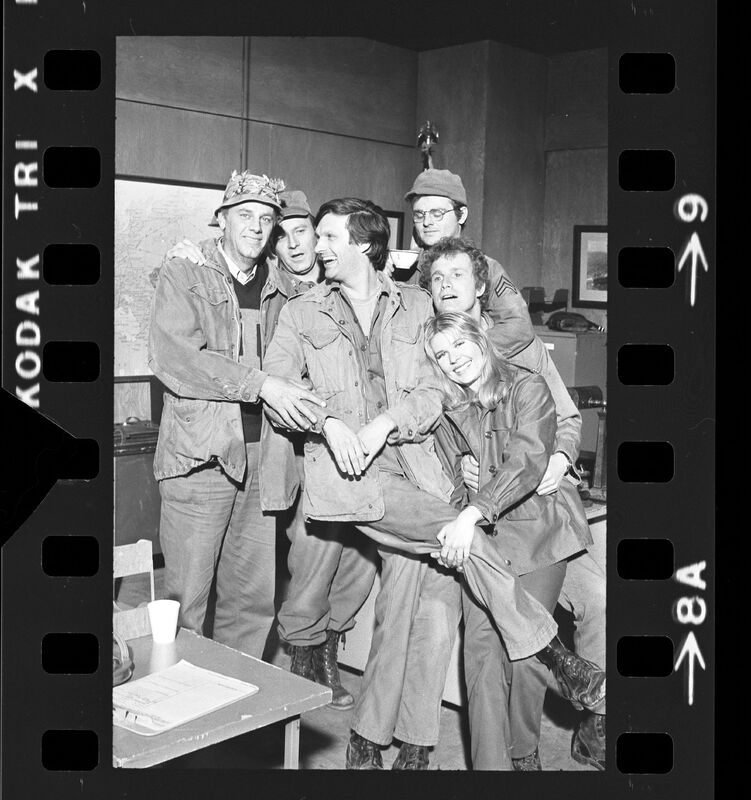
Original cast of M*A*S*H in 1973. From left to right, McLean Stevenson, Larry Linville, Alan Alda, Gary Burghoff, Wayne Rogers, and Loretta Swit.
A line of dialogue in the season four finale “Deluge” even makes a jab at the event of war itself. The episode serves as evidence of a soldier’s reality, and manages to draw a throughline from the years-gone Korean War to the--at the time--far more recent Vietnam war.
As the characters are hard at work in the operating room, the report of a major offensive by the Chinese army comes over the PA, with the announcer saying they “now face an entirely new war.” In response, Alan Alda's Hawkeye Pierce snidely remarks, “That’s for those of you who were tired of the old one.”
This characteristic throwaway line can be interpreted as a challenge to the idea of distinguishing between the Korean and Vietnam Wars. Thinking of Vietnam as the “entirely new war,” and Korea as the “old one,” turns this dialogue into the sentiment that from a soldier’s perspective, all war is the same.
The blurred line in M*A*S*H between the 1950s and the 1970s was perpetual, only growing over the course of the show, and there is no doubt the series both influenced and was influenced by the public perception of the Korean and Vietnam wars.