Pseudoscience and Racism
Pseudoscience has also historically taken the form of what is known as scientific racism: the act of using “science” and scientific methods to justify racial inequities. While these sorts of practices are referred to as pseudoscience today, many have been accepted as genuine scientific inquiry during their respective heydays and only later rejected.
One such example of these practices is known as phrenology. Phrenology is the now-considered-pseudoscientific practice of measuring people’s heads to determine what they are like as a person. As the chart on the right demonstrates, the skull would be divided up into numerous sections, each corresponding to some sort of personality trait.
Due to the print quality being so poor, it is fairly difficult to read, but traits in this example include things like the capacity for various kinds of love, the ability to mimic, and skills like the ability to understand the size and weight of objects.
People who practiced this “science” believed that the shape of the skull, dictated by how someone used their brain, could explain nearly every aspect of a person. This is unequivocally false, as the bumps on your skull have been shown to have no bearing on your ability to love yourself or judge the distance between yourself and another person.
Of course, this practice was also used to provide “evidence” for biological racial traits that justified the continued mistreatment of marginalized groups. This is even more important given that the golden age of phrenology was throughout the 1800s, and in the United States slavery was only federally outlawed in the 1860s. “Proving” that black folks had scientifically bad character meant that slavery, social inequalities, physical abuse, etc were all okay–or, worse, could be blamed on themselves.
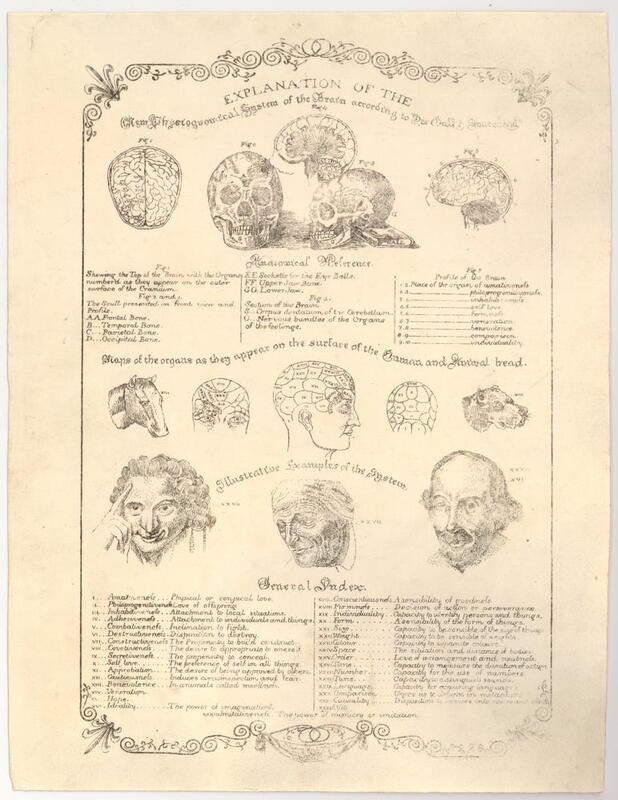
Explanation of the New Physiognomical System of the Brain Print
Unknown. Explanation of the New Physiognomical System of the Brain. ca 1818. The British Museum, London. © The Trustees of the British Museum. Shared under a Creative Commons Attribution-NonCommercial-ShareAlike 4.0 International (CC BY-NC-SA 4.0) licence. Print.
“It was phrenology, Combe told his audience, that best explained the history of the different ‘races of man.’ Holding up a Native American skull, Combe pointed out that ‘the Indian has more Destructiveness, less Cautiousness, less Benevolence.’ … In contrast, the ‘Negro’ was ‘gentler in nature’ and so more easily subdued.”

-James Poskett, Materials of the Mind: Phrenology, Race, and the Global History of Science, 1815-1920.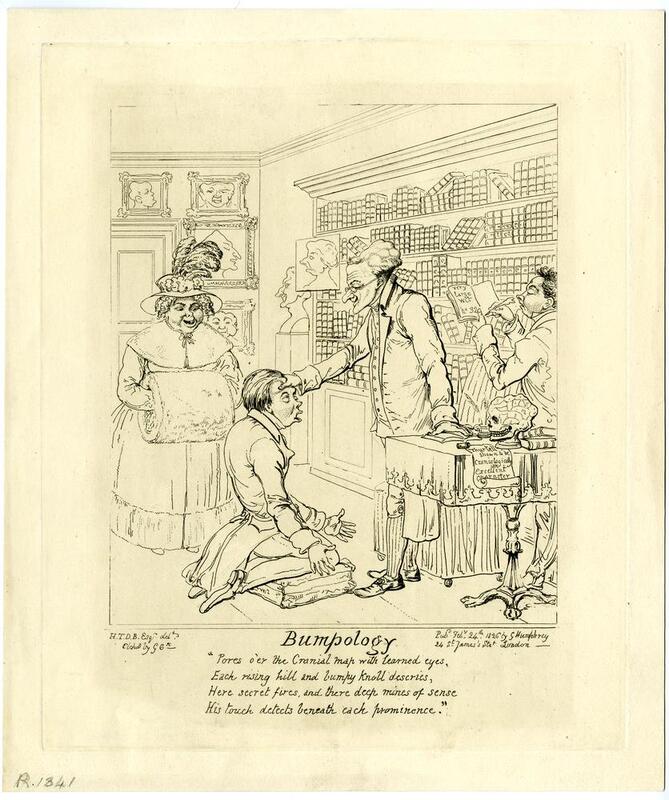
Bumpology Print
George Cruikshank. Bumpology. 1826. The British Museum, London. © The Trustees of the British Museum. Shared under a Creative Commons Attribution-NonCommercial-ShareAlike 4.0 International (CC BY-NC-SA 4.0) licence. Print.
Phrenology also provided opportunity and justification for the sale and trafficking of human remains. It was extremely common for phrenologists to have skulls for both demonstration, as mentioned in the above quote, and display. To the right is a piece which shows this well, as it illustrates a professor of phrenology giving a lecture in a crowded hall. The man has multiple skulls on his desk, at least four, to serve as demonstration pieces. It is highly unlikely, especially with skulls coming from people of color, that most phrenological skulls of the time were obtained with consent.
If there is any silver lining to this practice, it is that it wasn’t universally accepted. Phrenology endured much scrutiny, though by no means did that stop the practice. The satirical illustration on the left, “Bumpology,” inflates the skull-bumps to grotesque proportions to paint how ridiculous and self-serving this practice was. The phrenologist is also seen to keep a skull on his desk which is given the label of “an excellent character.” Ironically it is also labeled with the name of a well-known murderer at the time, John Thurtell, further pointing to the absurdity of the practice.
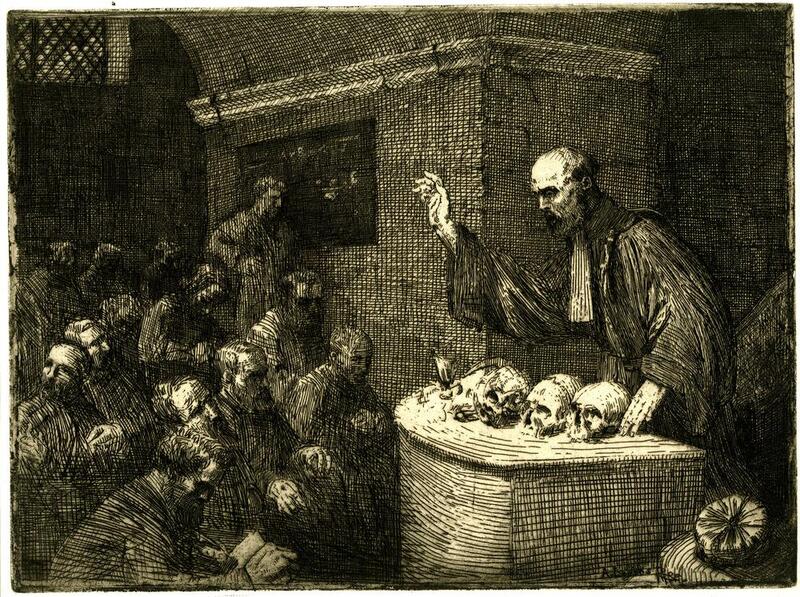
Le cours de phrénologie (The phrenology lesson) Print
Alphonse Legros. Le cours de phrénologie (The phrenology lesson). ca 1852-1877. The British Museum, London. © The Trustees of the British Museum. Shared under a Creative Commons Attribution-NonCommercial-ShareAlike 4.0 International (CC BY-NC-SA 4.0) licence. Print.
While phrenology had its heyday in the 1800s, medical racism is not just a thing of the past. Many people of color still receive unequal access to medical treatment on a systemic level, and worse care when they do receive it.
A belief that has pervaded the medical field for decades is that black patients do not feel as much pain as white patients. This misconception has led to an unknown amount of patients receiving inadequate care for their needs. Additionally, documentation of physical ailments has historically been illustrated only on fair-skilled patients. While this is changing, this still greatly affects patients’ ability to get diagnosed with life-threatening conditions. This disparity also reared its head during the COVID-19 pandemic.