Items
-
 Timothy Cole Jackson (2004-present) Curator of the Uniforms of the Napoleonic Wars.
 -
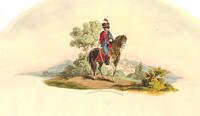 Portrait of Juan Palarea y Blanes The Peninsular wars (1808-1814) was the longest continuing conflict of the Napoleonic Wars, Former French ally Spain, revolted following the removal of the Spanish crown and the placement of Napoleon's brother Joesph, Guerrilla movements began to take part in the war, ambushing and raiding French troops. Depicted in the photo is Juan Palarea y Blanes "The Doctor" a Spanish doctor and soldier who became a guerrilla leader during the Spanish War of Independence, coming from a well off texile merchant family, he received upper levels of education becoming a doctor in Madrid. Following the war, he organized a militia movement starting with only 14 men. He and his militia took part in several major battles and skirmishes of the Peninsular campaign. He rose through the ranks of his unit, becoming the commander of the Hussars, and brigadier general. He was known to execute French soldiers he captured, and cut a ear of spies. He is wearing a French style Hussar uniform in red and blue, which uniformed Spanish light calvary militias wore these colors.
 -
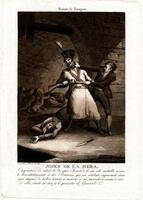 Ruins of Saragossa The peninsular wars (1808-1814) was one of the longest campaigns during the Napoleonic Wars, following Spain's alliance with France Napoleon boldly put his brother Joseph as king, this angered the Spanish and Portuguese as France was invading the Iberian peninsula. The Spanish and Portuguese organized guerrilla style warfare, largely different from the line battles and large calvary charges. This guerrilla warfare was street-to-street and brutal, civilians and militias took arms with the Spanish army to fight the French, the peninsular wars was considered the most "violent" campaign of the war, civilians were abused, stripped, and executed. This picture shows a fictional character in a series of novels "the Ruins of Saragossa" Josef de Hera fighting against the French, in many of these pictures he is in civilian workers clothes fighting French soldiers against the injustices of their cruelty. Behind the scene of the brawl, there is another dead soldier and a dead family in the alleyway.
 -
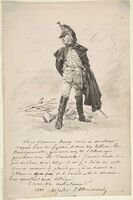 Letter to Samuel P. Avery with a drawing of a military figure Meissonier was a prominent artist of the 1800s he specialized in military art and depictions of troops. This letter was written because he felt dissatisified with a picture he made, 'le Renseignement' on how he drew some of the soldiers. In this letter on top is a picture of a French Dragoon in a overcoat worn during long marches and protected the uniform from fading and dirt. Translated from French: "Dear Mr. Avery here is a rough sketch of one of the figures in my beloved picture 'Le Renseignement', which you took from Germany for my friend Mr. Vanderbilt. I would have liked to have done it better, but such as it is, I leave it in your book as a souvenir of my pleasure in having seen the picture again, and of knowing it is in the hands of so distinguished an amateur, very cordially yours, 1880 21 July Meissonier"
 -
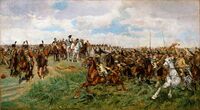 Friedland, 1807 Meissonier Ernest The Battle of Friedland (1807) in modern-day Kaliningrad Oblast near the town of Pravdinsk Russia. This battle was a deceive victory for France, from the Battle of Friedland Russia lost 40% of their entire army. Friedland crippled Russia, pushing them to pursue peace signing the Treaties of Tilsit. Where Russia joined the French army against Britain and the coalition. This picture captures the French army marching against the Russians, in the right side of the picture you have French Dragoons on the left you have light calvary in traditional Hungarian hussar uniforms. In the middle and on the side, has Napoleon and his commanding officers with some of his hussars wearing the modified Hungarian hussar uniforms with French shakos. columns of French grenadiers can be seen behind Napoleon.
 -
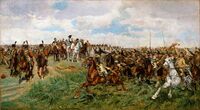 1807, Friedland Meissonier, Ernest (1861-75) The battle of Friedland (1807) was a major battle during the Fourth coalition. The Battle of Friedland between France and Russia where France crushed Russia's army. This lead to the end of the Fourth Coalition, and Russia pursued peace following this battle with the Treaty of Tilsit. This painting depicts a dramatic scene of the French army with infantry and calvary units preparing to charge the Russian army. The Calvary depicts the Dragoon units, and also units wearing more traditional Hungarian hussar uniforms. The commanders circle having hussars wearing modified version of the Hungarian hussar uniform with French shakos and plumes.
 -
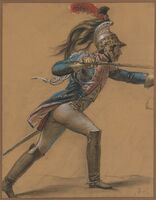 A French Dragoon, "The Revolt of Cairo." The French Dragoon Cavalry were sent in two regiments to Cairo during the Egyptian Campaign (1798-1801) several uprisings occurred during the French occupation one riot, the revolt of Cairo (1798) where Napoleon's army reacted with violence leading to thousands of civilians died, and several important mosques were destroyed. Following the deadly revolt which killed 300 French soldiers, Napoleon was harsh against them. punishing and executing those who orchestrated the revolt and imposed heavy taxes. This picture has a drawing of one Napoleon's Dragoon calvary likely the 14th regiment in a light blue uniform and cuissar helmet, with a leopard print across the helmet denoting power, and was said to of had the practical purposes of protecting from saber cuts.
 -
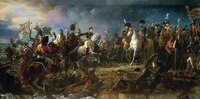 Battle of Austerlitz, December 2, 1805 The Battle of Austerlitz (1805) often referred to as the battle of the three emperors (Prussia, Russia, and France) this battle was a deceive French victory. This war was the end of the Third Coalition, it officially ended the Holy Roman Empire and also, put the German states under the control of Napoleon under the Confederation of the Rhine. This painting depicts a tense scene of diplomatic discourse amongst warring nations. On the left, is Napoleon with captured Russian soldiers being guarded by Mamluk soldiers enlisted from the African campaigns. The Third coalition on the right with captured regiment standards trading captured prisoners including the Commander of the Russian Imperial Guard Prince Repnin-Volkonski (1778-1845).
 -
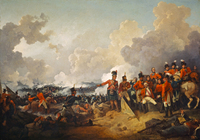 Battle of Alexandria, 21 March 1801 The Battle of Alexandria in (1801) was one of Napoleon's first campaigns and deepened tensions between the Coalition and France. Britain had a large show of force, including Scottish Highlanders 42nd Black Watch and Irish soldiers who took part along side British soldiers. The British forces 40th, 23rd, and 58th regiment of foot crushed French troops in Naval and land combat. This photo has several Scottish and Irish troops, on the right side rendering aid to Sir Ralph Abercromby who later succumbed to wounds during battle. French and British troops are seen in the background fighting.
 -
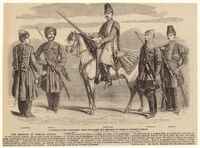 Uniforms of the different corps composing the emperor of Russia's personal escort The Cossacks were comprised of multi ethnic groups of Slavic and Turkic peoples. Don Cossacks primarily lived in Ukraine and Southern Russia. Mussulman were ethnic Russian Muslims from the Northern Caucuses and Tatarstan. Circassians inhabited the Northern coasts of the black sea. Lesghians , and Lesghians inhabited Azerbaijan and Russia. This photo features five men of various regions the Steppe region Cossacks who were employed by the Russian army. They wear many of the traditional dress, and were exotic in appearance compared to the plain dark green Russian army conscript.
 -
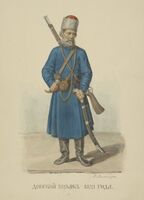 Don Cossack of the year 1821, Grigor'evich Fedor The Cossacks were apart of the back bone of the Russian army during the Napoleonic wars, Cossacks are groups of runaways soldiers, serfs, and criminals of Russian, Persian, and Turkic ethnicities hiding in the Steppes region of modern day Ukraine, Southern Russia, and the Caucuses , Cossacks were skilled light calvary and infantry units, often cossacks scouted enemy positions and ambushed routes. Napoleon on several occasions had to defend themselves from the hordes of Cossacks during the Russian campaign (1812) and barely made it out alive, losing many French Imperial Guards in the process. This picture features a Don Cossack from Southern Russia. He is dressed in traditional Cossacks dress and a Papakha fur hat. He is armed with a curved saber.
 -
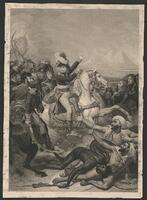 Napoleon at the battle of the Pyramids, July 21st 1798. One of Napoleon's first conquests was Egypt (1798), he crushed the Egyptian and Mamluk armies. Mamluks are slave soldiers who were captured from all over the world and sold to sultans and amirs as boys who are trained to be soldiers and servants. The photo shows Napoleon and officers by the pyramids with two defeated Mamluks on the floor.
 -
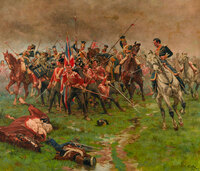 The Flag of Albuhera, May 16, 1811, Wollen Barns William. This picture depicts French Army, Polish Uhlan and French lancers encircling the British 1st and 3rd of foot regiment troops during the peninsular wars. During the Battle of Albuera (1811) Where French forces attacked Spanish and British troops during the peninsular wars.
 -
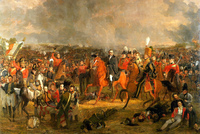 The Battle of Waterloo, Pieneman Willem Jan, 1824 The Battle of Waterloo (1815) was the last war of the Napoleonic wars, the defeat of Napoleon and his loyalists. The end of the First French Empire. Many countries took arms to fight against France, including the United Kingdom, Netherlands, Prussia, Hanover, Bassau, and Brunswick. This was a multi nation front that wasn't seen until now. Many generals, officers and soldiers were involved totaling around 120,000 troops under Wellington and Blücher. This painting features many notable generals including, ieutenant-General Lord Uxbridge (Britain), Lieutenant Colonel Jhr. WF Boreel (Dutch), Baron De Constant de Rebeque (Swiss), Major General AKJG d'Aubremé (Netherlands), and many more notable people of different nations. This picture has war being waged in the background and sides, and the front having a delegation of officers under the bodies of several fallen soldiers.
 -
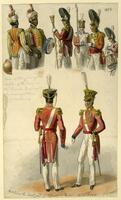 Courtyard at St. James Palace, Bois de Boulogne. Scharf George, 1831 Pictured is two sections of a paper, the top having six British soldiers, four grenadiers and fusiliers alongside two "orientals" with tambourines who were Turkish, African, and Indian men recruited by the British East India company. The bottom portrait of a 2nd Foot Guard Coldstream Guard who have served continuously under the British since the 1600's. George Scharf, born several years after the Napoleonic Wars was an artist and critic. Later becoming the Director of the National Portrait Gallery drew many photos of soldiers uniforms at a young age.
 -
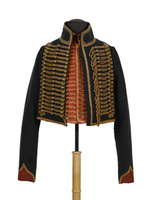 Dolman of the Calvary Imperial Guard The Imperial Guard Calvary Chasseurs à Cheval de la Garde were the main light calvary consisting of two regiments of the Napoleon's Imperial Guard, they were the calvary "Old Guard" They were formed during the Italian Campaign (1796) These regiments were very revered and respected of the Hussar regiments, not only did they protect Napoleon from attacks at his forts, but they also preformed maneuvers against the enemy to change the tides of war. From stomping the Russian Imperial Guard in the battle of Austerlitz (1805), defending Napoleon from a large attack of Cossacks at the Battle of Gorodnya (1812). After the battle of Waterloo (1815), they were disbanded entirely. This dolman is in a dark green wool with a red undershirt. The sleeves made of scarlet fabric. This piece was sewn by a seasoned tailor, this uniform was designed in the sewing process to give more movement freedom, because of how it was sewn with the seams by the collar with pleats.
 -
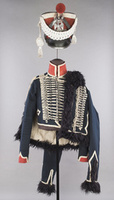 3rd Honor Guard pelisse, dolman, and shako Following the heavy losses during the Russian campaign (1813) where many Imperial Guard were killed, Napoleon looked to civilians and lower nobility who were trained on horses to supplement the Imperial Calvary. Napoleon formed the 3rd Honor Guard regiment in 1813, they had several successful campaigns including Leipzig (1813) and Reim (1814). Following Napoleon's exile to the Island of Elba, King Louis XVIII disbanded the guard, and absorbed some of the troops into his personal bodyguard. The dolman edged with black sheepskin fur and white braids, there are eighteen rows of silver buttons, and eighteen white braids across the chest and pelisse. The red shako with a red pom-pom has a hussar cord draped across the front of the and side of the shako with a silver French eagle on the front.
 -
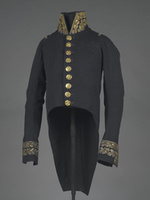 General Drouot's Campaign tailcoat dark blue artillery tailcoat with golden embroidered sleeves and collar, with golden buttons with the artillery Corp insignia. Belonging to General Antoine Drouot who served in as an artilleryman during the French revolution and quickly rose through the ranks becoming a captain in the battle of Hohenlinden (1800). After several victorious battles, notably the battle of Wagram (1809) he was made commander of the Imperial Guard artillery, becoming an assistant to Napoleon. Drouot went with Napoleon to the first exile at the Elba Island, where he served with Napoleon during the battle of Waterloo as commander of the Imperial Guard.
 -
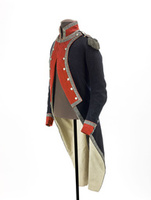 Uniform of the French Imperial Guard Early "small" regulation model uniform of a NCO Fusilier. Adorned with Silver colored epaulettes and embroidered silver collar, sleeves, and chest. Silver buttons on a dark blue tunic on a red chest. The French Imperial Guard were the body guard unit that was under the direct command of Napoleon during battle. They composed of elite soldiers of the army, often veterans of French and allied nations that showed exceptional work in the field. It was divided from the most elite "Old Guard" and the less experienced middle and young guard. A full unit equipped with calvary and artillery units, they participated in many famous battles during the war changing the tides of the battle.
 -
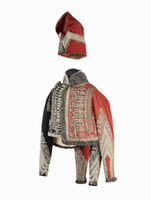 Hussar Dolman and Pelisse, Prince Fredrick IV of Salm-Kyrburg Dolman and Pelisse of the 6th Hussar regiment. This striking uniform is laced with silver buttons and rope across the sleeves, chest and collar. The pelisse being made from thick Moroccan Leather. With a red police Bonnet cap. Fredrick IV, Prince of Salm-Kyrburg (Frederik Ernst Otto Philip Anton Furnibert) born in France resided over in modern day Rhineland-Palatinate, Germany, Graduated from Saint Cyr Military Academy in France, considered the best academy in the country. His military service is unknown, however, the 6th Hussar regiment saw extensive combat throughout the war including the invasion of Moscow (1812), Battle of Jena(1806), and Waterloo(1815).
 -
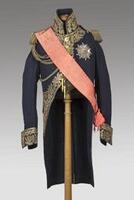 "Grand" Divisional General's Uniform, Bertrand, Henri-Gatien Blue and gold embroidered, and embossed Major General's uniform of the First French Empire, it is in the general's "grand" regulation dress blouse, with golden embroidered epaulettes with three silver silver stars, golden Aiguillette cord on the right shoulder, and golden buttons. On the left breast is the grand eagle of the Legion of Honor. With a red sash of Division Generals across the torso. belonging to General Count Bertrand (1773-1844) who served as Napoleon's aide-de-camp (assistant) later becoming the Grand Marshal of the Palace. A devout general who accompanied Napoleon to both of his exiles to the islands of Elba and Saint Helena.