Social Class in the Uniforms
The 3rd Honor Guard the light calvary of Napoleon's Imperial Guard, filled the role of the needed calvary unit after most of the Imperial Guard hussars were wiped out after the Battle of Borodino (1812) and the subsequent retreat after finding Moscow burnt to the floor by Russian patriots. Napoleon conscripted the help of French civilians, primarily men from household rulers and lower nobility lines who were already trained in horseback manuevers and were able to pay for their uniforms and supply to guard him. The 3rd Honor Guard Regiment had several successful battles at Leipzig (1813) and Reim (1814).
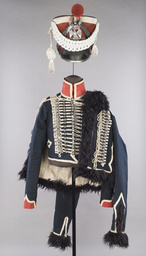
Pictured here is a Hussar dolman, pelisse, and shako in a French adaption of the tradtional Hungarian Hussar uniform. The dolman draped on the left shoulder lined with black sheepskin fur and white braids. The uniform's pelisse, with eighteen rows of silver cords and silver buttons. The red shako adorned with the Hussar cord, and silver French eagle on the front.
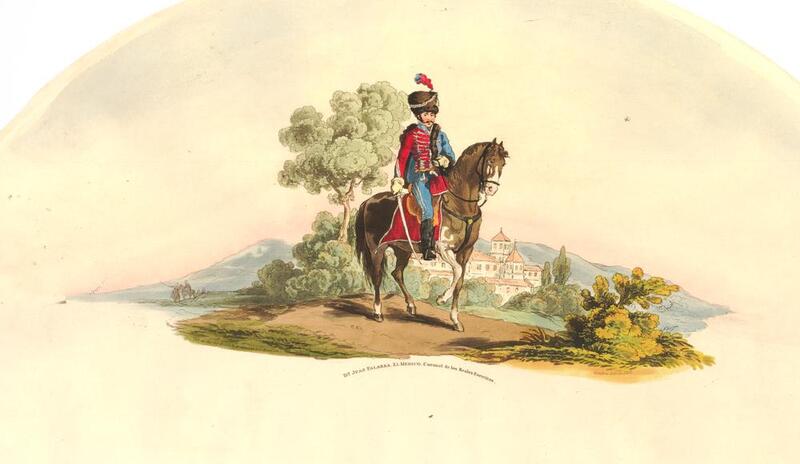
The Peninsular war campaign (1808-1814) during the Napoleonic wars was a brutal several year long campaign in Spain and Portugal with street-to-street combat often resulting in large civilian death, it is often considered the most "brutal" wars, militia organizations were prevelent during the battles against the French, although many of the irregular militiamen wore civilian clothing, more prominant and well off Spanish men enlisted as light calvary hussars.
In this picture depicts Juan Palarea y Blanes "the doctor" (1780-1842) who was from a well-off merchant family became a doctor when the war kicked off he formed a small militia band comprising of only 14 men at the beginning they gained notability throughout the Spanish guerrillas fighting in several major battles and conducting sabatoage missions. He was a Colonal of his brigade before creating a mounted unit which he was the lead hussar, he is wearing the spanish militia hussar a copy of the traditional Hungarian hussar uniform in blue and red, and silver buttons and ropes across his chest. A common hussar of the Spanish militias.
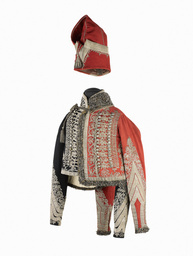
Following the Confederation of the Rhine when Napoleon crushed Austria and Russia in the battle of Austerlitz (Czechia, 1805) where several German muncipalities removed from the Holy Roman Empire were put under the control of Napoleon's France. Many of the German people were enlisted into the army. Including those of nobility lines, many of the nobility were trained in horses, this made them important in conscripting them in calvary regiments. They are already trained, have the proper means to fund taking care of their horses and equipment. Although unknown what battles Prince Fredrick IV of Salm-Kyrburg (1789-1859) fought in, but he served later into the Napoleonic Wars, one photograph published has the prince in many medallions and awards, indicating long and distinguished military service.
Photographed is Prince Fredrick IV of Salm-Kyrburg's Hussar dolman, pelisse, and French police cap. His uniform colorations of red and black indicate he served in the 9th Hussar Regiment. Silver buttons and silver laced rope around the dolman and the pelisse jacket.
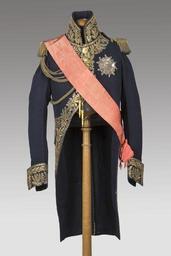
Blue and gold embroidered, and embossed Major General's uniform of the First French Empire, it is in the general's "grand" regulation dress blouse, with golden embroidered epaulettes with three silver silver stars, golden Aiguillette cord on the right shoulder, and golden buttons. On the left breast is the grand eagle of the Legion of Honor. With a red sash of Division Generals across the torso.
belonging to General Count Bertrand (1773-1844) who served as Napoleon's aide-de-camp (assistant) later becoming the Grand Marshal of the Palace. A devout general who accompanied Napoleon to both of his exiles to the islands of Elba and Saint Helena. General Bertrand came from a linage of high nobility, where he married the daughter of general Arthur Dillon (1750-1794) and her mother was a cousin of Empress Josephine (1763-1814) the wife of Napoleon I. He was deeply loyal to Napoleon he held command of the French army in pivotol moments in the war during the Battle of Leipzig (Germany, Leipzig), Wartenburg (Germany, Kemberg), and Dennewitz(Germany, Juterborg near Berlin). He was also appointed govenor of the Illyrian Provinces, and was one of Napoleon's most favorite generals following his victory of Leipzig forcing the German states to be under control over the French.
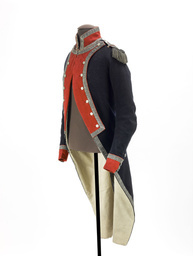
Early "small" regulation model uniform of a NCO Fusilier. Adorned with Silver colored epaulettes and embroidered silver collar, sleeves, and chest. Silver buttons on a dark blue tunic on a red chest. Although they were an elite regiment of the army, their uniforms reflect a simpler design less elegence more ultility reflecting the wealth differences of those they protected. Many of these soldiers came from poor and lower middle class families enlisted or conscripted into the army who found their profession as elite soldiers of the army.
The French Imperial Guard were the body guard unit that was under the direct command of Napoleon during battle. They composed of elite soldiers of the army, often veterans of French and allied nations that showed exceptional work in the field. It was divided from the most elite "Old Guard" and the less experienced middle and young guard. A full unit equipped with calvary and artillery units, they participated in many famous battles during the war changing the tides of the battle, protecting Napoleon and the generals in their posts. While being used as reinforcements for a collapsing line.
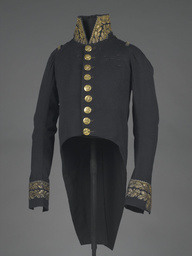
dark blue artillery tailcoat with golden embroidered sleeves and collar, with golden buttons with the artillery Corp insignia.
Belonging to General Antoine Drouot (1774-1847) who served in as an artilleryman during the French revolution and quickly rose through the ranks becoming a captain in the battle of Hohenlinden (1800). After several victorious battles, notably the battle of Wagram (1809) he was made commander of the Imperial Guard artillery, becoming an assistant to Napoleon. Drouot went with Napoleon to the first exile at the Elba Island, where he served with Napoleon during the battle of Waterloo as commander of the Imperial Guard.
- 1803
- Description
- The Imperial Guard Calvary Chasseurs à Cheval de la Garde were the main light calvary consisting of two regiments of the Napoleon's Imperial Guard, they were the calvary "Old Guard" They were formed during the Italian Campaign (1796) These regiments were very revered and respected of the Hussar regiments, not only did they protect Napoleon from attacks at his forts, but they also preformed maneuvers against the enemy to change the tides of war. From stomping the Russian Imperial Guard in the battle of Austerlitz (1805), defending Napoleon from a large attack of Cossacks at the Battle of Gorodnya (1812). After the battle of Waterloo (1815), they were disbanded entirely.
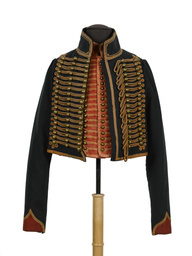
This dolman is in a dark green wool with a red undershirt. The sleeves made of scarlet fabric. This piece was sewn by a seasoned tailor, this uniform was designed in the sewing process to give more movement freedom, because of how it was sewn with the seams by the collar with pleats. This dolman and pelisse represents the wealth needed to be a hussar, many of the hussars came from lower nobility wealthy backgrounds and were already trained in horseback as a sport, armies recruited many of them to be in the calvary as training and supplying equipment is very expensive.
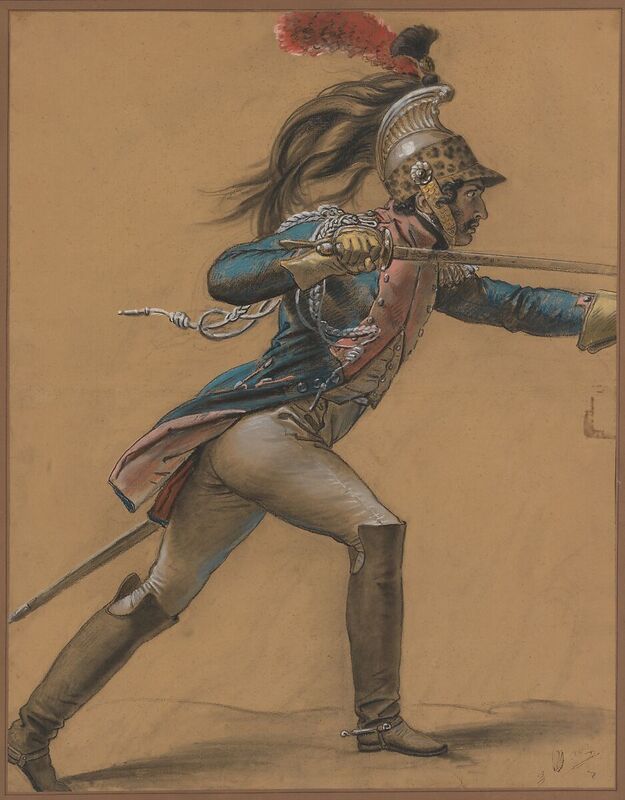
- The French Dragoon Cavalry were sent in two regiments to Cairo during the Egyptian Campaign (1798-1801) several uprisings occurred during the French occupation one riot, the revolt of Cairo (1798) where Napoleon's army reacted with violence leading to thousands of civilians died, and several important mosques were destroyed. Following the deadly revolt which killed 300 French soldiers, Napoleon was harsh against them. punishing and executing those who orchestrated the revolt and imposed heavy taxes.
This picture has a drawing of one Napoleon's Dragoon calvary likely the 14th regiment in a light blue uniform and cuissar helmet, with a leopard print across the helmet denoting power, and was said to of had the practical purposes of protecting from saber cuts.
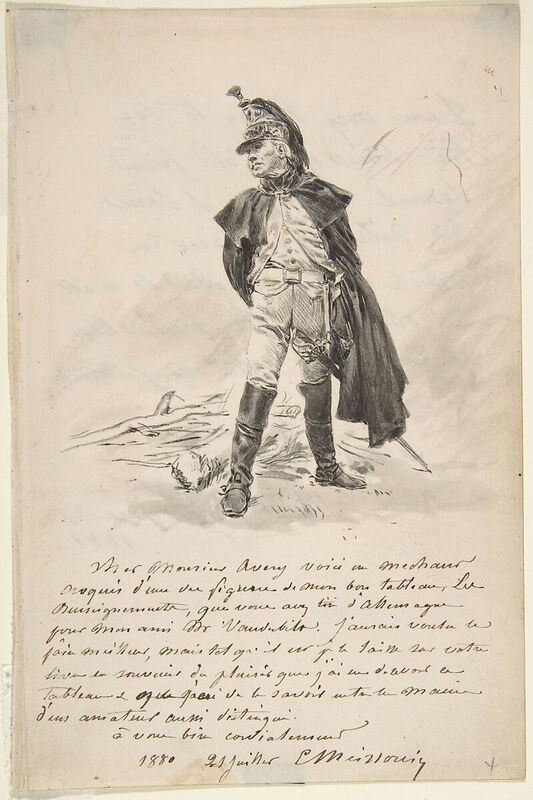
Meissonier was a prominent artist of the 1800s he specialized in military art and depictions of troops. This letter was written because he felt dissatisified with a picture he made, 'le Renseignement' on how he drew some of the soldiers.
In this letter on top is a picture of a French Dragoon in a overcoat worn during long marches and protected the uniform from fading and dirt.
Translated from French: "Dear Mr. Avery here is a rough sketch of one of the figures in my beloved picture 'Le Renseignement', which you took from Germany for my friend Mr. Vanderbilt. I would have liked to have done it better, but such as it is, I leave it in your book as a souvenir of my pleasure in having seen the picture again, and of knowing it is in the hands of so distinguished an amateur, very cordially yours, 1880 21 July Meissonier"