Daniella Collection
Item set
Items
-
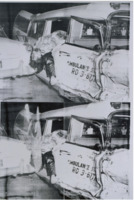 Ambulance Disaster This Warhol print takes part of the Death and Destruction, Death and Disaster, or Death in America series exhibition that he made. Rather than focusing on the wreckage of the crash, in Ambulance Disaster the victims’ mangled bodies take center stage and bystanders are removed entirely. The central figure, with arms outstretched, carries a dramatic resonance reminiscent of the extended arms found in crucifixion imagery throughout western art. Two ambulances colliding while attempting to usher victims to safety represent a surreal tragedy of mythic proportions
 -
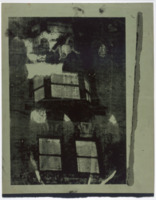 Suicide This print depicts an image of building with three windows representing floors escalating in height. From third balcony window their can be seen a person in a white night gown of sorts falling back first onto the ground. Although a morbid image it represents one of the many depictions of suicide that Warhol produced for his exhibition called Death in America, which highlighted how people seeing images of atrocities made them no longer care for these tragedies.
 -
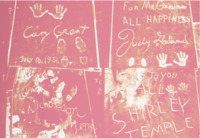 Sidewalk This screen print of a sidewalk has a salmon pinkish color to it making the engravings and imprints in the sidewalk more visible. This particular sidewalk has the hand prints, foot prints, and engravings of Judy Garland, Shirley Temple, Jack Nicholson, and Cary Grant. These stars ranged from the 50s to the 70s. As well, the print looks as if it were two sidewalks in separate locations that Warhol decided to put side by side for the print. This brings up the question of why these four stars in particular? Besides that this print builds on the slow interconnectedness between art and pop culture that occurred during the Pop Art movement.
 -
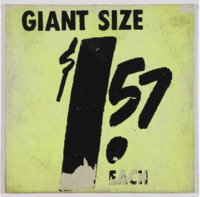 $1.57 Giant Size This screen print is like other screen prints Warhol produced that were made to mirror or parody consumer magazines and adds. This one provides an example of how Warhol would often choose to purposefully put errors or flaws in the screen print, i.e the lack of tint at the bottom of the 1 and the word each, instead of making perfect copies of the media. This continues his statement on consumerism in the US and the ways in which magazines and advertisements focused on quickly getting the viewers attention rather than deep content.
 -
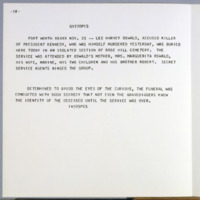 Flash-November 22, 1963: Text, Pages 17-18 This 1968 portfolio used Teletype texts reporting the assassination of President John F. Kennedy. By screenprinting the Teletype texts, Warhol could relay the unfolding situation. However, Warhol used the news story and created the screen prints more than four years after it first shocked the nation. He did this in particular to speak on the media and public's obsession with tragedy and portraying all news events as horrible. This is not to say that the assassination wasn't horrible, but rather was Warhol's manner of underlining how no one could escape feeling sad due to how the television and radio programmed the public.
 -
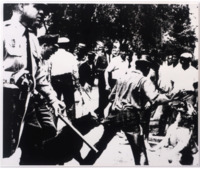 Birmingham Race Riot This screen print of an image of the Birmingham Race Riots is similar to other Warhol prints of current news reports. The Birmingham Race Riots were a protest against segregation that was met with violent police action. The Race Riots of the 60s were a key part of the US Civil Rights Movement. By printing an image of the event Warhol highlights the issues people face on the daily. As well, he provides purely the image of the riot not a biased news report as a newspaper would, allowing the viewer to truly sit with the violence in the image.
 -
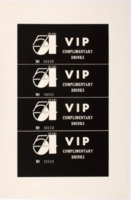 Studio 54 Complimentary Drink Invitation This print contains 4 differently numbered complimentary drink invitations to Studio 54. Studio 54 is located in Midtown Manhattan, and was a nightclub infamous for its celebrity guest lists, quixotic entry policies, extravagant events, rampant drug use, and sexual hedonism. Warhol was one of the frequent guests to this club, and made many artist and popular celebrity connections, like Carolina Herrera mentioned before. The four invitations in the screen print, look as if they can be ripped or separated to use them alone. As well, the invitation allows for a VIP pass into the studio alongside the complimentary drinks.
 -
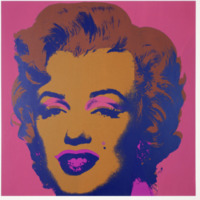 Marilyn Monroe (Marilyn) This Marilyn screen print fully demonstrates the way in which Warhol utilized the screen printing technique to make multiple and varied prints. This further speaks on consumerism and how that era had made it so much easier to reproduce images with no real variance besides color. The screen printing technique that is used to make newspapers and magazines, being used in the context of art also worked to blur the lines between class and art. The prints, like the one here, show Marilyn Monroe’s face rendered in unnatural shades. In this print Warhol used red hues with their being a red background, Monroe's face being an orangey hue and her hair, eyebrows, eyes, and shaded nose area are in a darker purple color. The color that stands out the most is the bright hot pink that covers her eyelids and lips. Warhol varies the colors from natural flesh tones, underlining how screen printing allowed him to use the image as blank canvas for him to customize. As well the choice to represent her in unnatural colors provided her with a legacy that did not revolve solely around her looks and beauty. As well, by not forcing himself to stick to natural colors, it allowed him endless combinations of prints that he could produce of her. Using such an important and recognizable figure for his screen prints, connected pop culture and art in a new way, while also making it widely accessible and relatable to a general audience.
 -
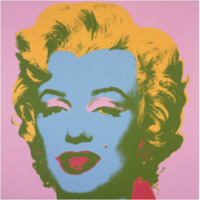 Marilyn Monroe (Marilyn) This print is part of the many prints Warhol produced of Monroe, following her death. The prints, like the one here, show Marilyn Monroe’s face rendered in unnatural shades. Compared to the other one her face is blue, with pink eyelids, and bright red lips. Warhol varies the colors from natural flesh tones, underlining how screen printing allowed him to use the image as blank canvas for him to customize. As well the choice to represent her in unnatural colors provided her with a legacy that did not revolve solely around her looks and beauty. As well, by not forcing himself to stick to natural colors, it allowed him endless combinations of prints that he could produce of her.
 -
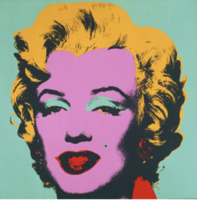 Marilyn Monroe (Marilyn) This is one of Warhol's most iconic screen prints, and so memorable due to the icon Marilyn Monroe being the muse. Warhol used a cropped publicity still taken by Gene Korman from Monroe’s 1953 film Niagara as the base for more than 50 paintings and dozens of prints. The amount of prints he made significantly contributed to the enduring popularity of the star’s image, as one beyond her beauty. The prints, like the one here, show Marilyn Monroe’s face rendered in unnatural shades. Warhol varies the colors from natural flesh tones, underlining how screen printing allowed him to use the image as blank canvas for him to customize. As well the choice to represent her in unnatural colors provided her with a legacy that did not revolve solely around her looks and beauty. As well, by not forcing himself to stick to natural colors, it allowed him endless combinations of prints that he could produce of her.
 -
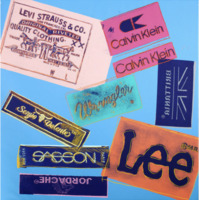 Jean Labels In this painting, Warhol depicts all of the jean labels of the companies that produced jeans at the time. He puts the label of Levis, Calvin Klein, Lee, Sasson , Sergio Valentes, Jordache, Wrangler, and Brittania. Each label is basically copied onto the canvas, having any and all smaller words that would be present on the label on the painting. Continuing the Pop Art motif of consumerism and using ads and propaganda to make art, Warhol's Jean Labels painting speaks on the consumerist society and the companies that are geared towards them.
 -
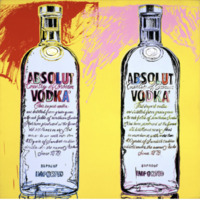 Absolut Vodka This painting depicts two bottles of Absolut Vodka, with one on the left having a slight yellow underline to it and the one on the right having a stronger grey outline. On the front of the bottles Warhol put the exact inscription/writing that would be on the real bottles. Similar to the Campbell's soup cans, this painting has a deeper tie to the consumerist tendencies of the US during the period. Using this alcohol speaks to society and his audience.
 -
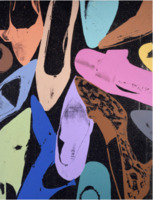 Diamond Dust Shoes (Random) Warhol had a fascination with women’s shoes throughout his whole career. He had created shoe drawings as gifts for friends, and mounted an exhibition dedicated to the look of women's shoes. Warhol himself collected shoes, which were the same ones he would set against black backgrounds and cover with reflective “diamond dust" to create a piece such as this one. In particular he had an interest in shoes designed by Halston. Through his broader Shoe series he could best invoke the glitter and glitz of the fashionable celebrities who would wear the types of heels he collected.
 -
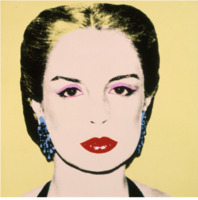 Carolina Herrera In this painting, Warhol painted a friend of his Carolina Herrera. Herrera, a Venezuelan-American fashion designer, moved to New York City in 1980 and was quickly recognized for her first successful fashion line.Studio 54 was where the two met, and Warhol offered to paint her portrait in exchange for a bejeweled clutch of hers. Herrera was a well-known designer who remains an internationally renowned designer and has dressed notable figures throughout her career.
 -
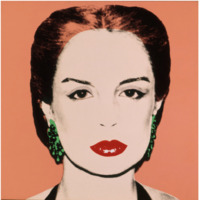 Carolina Herrera In this painting, Warhol painted a friend of his Carolina Herrera. Herrera, a Venezuelan-American fashion designer, moved to New York City in 1980 and was quickly recognized for her first successful fashion line.Studio 54 was where the two met, and Warhol offered to paint her portrait in exchange for a bejeweled clutch of hers. Herrera was a well-known designer who remains an internationally renowned designer and has dressed notable figures throughout her career.
 -
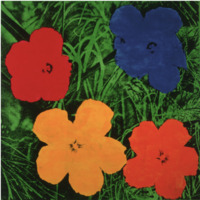 Flowers This painting is demonstrative of Warhol's bright colors style when creating art. He produced the Flower painting in different sizes from miniature to monumental, making them all for a gallery exhibit in which they were arranged to fully cover the walls. He did have a source for the painting, which was Patricia Caulfield's color photograph of hibiscus flowers that appeared in a magazine. Although the painting is simple and bright presenting the flowers in a straight-forward manner, there was some controversy around this piece. Caulfield, the original photographer sued to maintain ownership of the image. This marked an important point in Warhol's career, and presented the ongoing argument about an artist's ability to appropriate from existing sources.
 -
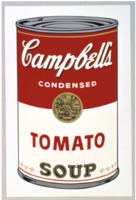 Campbell's Soup I: Tomato Similar to many other Warhol depictions of Campbell soup, this can is a tomato soup can. He uses the same screen printing technique to create this one, and actually created this one before the Scotch Broth and Golden Mushroom Campbell soup, yet under the same group of 1 with Chicken Noodle. By keeping the exact look of the can he connects with a broader audience over a product that was well-known across the US. Warhol is able to speak on the effects of consumerism by parodying the cans himself. By bringing all these depictions of consumerist cans together, all these screen prints together speak on the predictability of advertisement and the true over-dependence on it.
 -
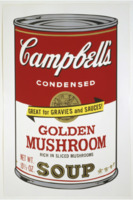 Campbell's Soup II: Golden Mushroom This Campbell's soup is part of the Campbell's II which Scotch Broth was also a part of. He uses the same screen printing technique to create this one, and actually created this one on the same year as the Scotch Broth Campbell soup. By keeping the signature look of the can he connects with a broader audience over a product that was well-known across the US. By producing many of the same rendition of can, solely the different flavors of soup, Warhol can further prove his argument made through art on the consumption habits of the US at the time, and the art that became advertising.
 -
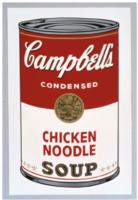 Campbell's Soup I: Chicken Noodle Similar to many other Warhol depictions of Campbell's soup, this can is a chicken noodle soup can. He uses the same screen printing technique to create this one, and actually created this one before the Scotch Broth Campbell's soup. By keeping the exact look of the can he connects with a broader audience over a product that was well-known across the US. Warhol is able to speak on the effects of consumerism by parodying the cans himself.
 -
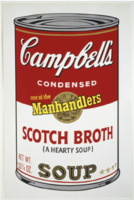 Campbell's Soup II: Scotch Broth This Campbell's screen print alongside many others was a popular and reoccurring moment for Warhol's career. His use of screen printing allowed him to perfectly recreate the readymade commercial imagery, mechanical manufacture, and signature look of the soup cans. In the screen print he keeps the familiar red-and-white label of a Campbell’s Soup can, making it instantly recognizable to anyone in the audience, regardless of their social or economic status. However, he specifically depicts a Scotch Broth soup in this can print. He chose Campbell's soup, a product that was representative of the time and fed into the Pop Art's perspective on consumerism and its effects on people and their critical art deduction skills. By using an item that could be found at any supermarket he connects to his audience and broke the barriers of arts classist ways.
 -
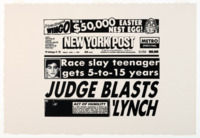 New York Post (Judge Blasts Lynch) This piece represents one of Warhol's many screen prints. In this one he intentionally used an article that headlined “Judge Blasts ‘Lynch Mob,’” that recounted the sentencing of the first among a group of white teenagers who beat a black transit worker to death in 1982. Warhol however cropped the word “mob,” leaving only "Judge Blasts 'Lynch," forcing the viewer to puzzle out the meaning. Warhol also decided to eliminate the image that accompanied the “Act of Humility” caption at the bottom left of the original newspaper, which showed Pope John Paul II washing the feet of a homeless boy in Rome. This further emphasized the picture of the boy arrested and the headline about the act that occurred.
 -
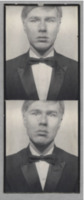 Self-Portrait (Tuxedo) In two photobooth style pictures, one on top of the other and connected, is depicted a 36 year old Warhol alone. He is wearing a tuxedo and bow tie with his hair combed to his right side. In both pictures he has a serious look on his face with his head slightly tilted to his left in the bottom picture. The photobooth picture is in black and white.
 Daniella Ferrero picture