Death and Destruction
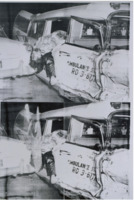
Gene Swenson, an influential art critic and curator at the height of the Pop Art movement and well-known journalist for ARTNews, provided an interesting perspective on some of Warhol’s pieces. For a movement so tied with depersonalization, Swenson highlighted how Warhol’s series of silkscreen paintings, Death in America, which depicted car crashes, suicides, electric chairs, and so on, made the viewer deal with public and shared feelings. This doesn’t necessarily negate the conceptual idea of depersonalization within the pop art community, but rather emphasizes the transition from an art piece needing to depict or be built on the artist’s private feelings and instead be representative of public, communal feelings. Swenson wrote for his flier, The Personality of the Artist, “These paintings mute what is present in the single front page each day, and emphasize what is present persistently day after day,” illustrating this new found optimism he had for the pop art movement. His optimism was short-lived as it became clear to many at the time that within the Pop artist community there were contradictory opinions on the relationship between art and reality, making it difficult for a single definition that all identified with to be made.
The Death and Destruction, Death in America, or Death and Disasters series (its name changed and varied depending on the source) was one of Warhol's most impactful series. As with much of Warhol's work, repetition is a major feature: the same image is often repeated multiple times in a single piece, mirroring the omnipresence of such imagery in the media and having a desensitising effect on the viewer. He also often employed bright, incongruous colours in these works, contrasting the grim subject matter with his pop sensibility. The series can be seen as a commentary on the way the media presents and consumes tragedy. Warhol seemed to be making a statement about the detached and mechanical way in which society encounters and processes these horrific events. By presenting them in a repeated and almost commercial format, he raises questions about desensitisation of the public and the nature of celebrity. Furthermore, the subject matter encapsulates the apocalyptic fears of the Cold War generation in the United States.
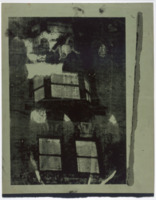
Although this particular Warhol series is quite morbid it does highlight another way in which Warhol was able to use his art and the Pop Art movement to call out the general public and make art personal. By stating that these people were desensitized to tragedies and making a whole series on repeated images of these disasters it makes it so that these people see the hypocritical nature in which news is provided. Through this exhibit he could more clearly demonstrate to the general public how the way in which newspapers through images of death and disasters in the faces of people all the time made it so that people wouldn't care anymore at the sight. Warhol, like the rest of the Pop Art artists, felt that he could use his art to highlight the consumerist and mass produced nature of the US and solidify how negatively this was impacting people. At the same time this use of mass produced images, as morbid as they may be, further connects to the day-to-day person and allows them to view and interpret art without the guise of an elitist institution.