-
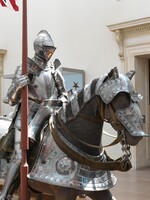 Armor for Man and Horse
 Steel armor outfitting a man and a horse. The man is sitting upright in an active riding position. The armor is incredibly decorative with etched decorations on both the man and horses armor. Lochner's makers mark, the lion, is on the mans armor as well as the mark of Nuremburg and date 1548.
-
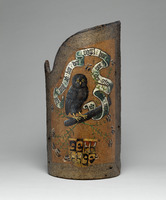 Tournament Shield (Targe)
 A tournament shield depicting a painted black owl foregrounded on a brown field. Around the owl are the words "Although I am the hated bird, I rather enjoy that". This shield has a slot on the right side where a jouster would have guided a lance.
-
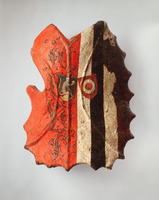 Shield for the Field or Tournament (Targe)
 A very unique and striking shield. This shield has raised ribs on its surface to aid in the shattering of a lance. The edges of the shield are scalloped. Right side has a slot where the lance would rest. Half of the shield is red with the other half being black and white stripes. Painted over this design are two small shields with the arms of two Nuremberg patrician families. On the red side is the heraldry of the Ketzel family (on a black ground, a silver monkey holding a gold ball) and on the black and white side is the heraldry of the Koler family (on a red ground, a silver ring).
-
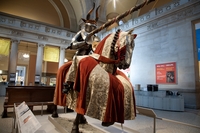 Armor for the Joust of Peace
 Full set of tournament armor for man and horse used in the Joust of Peace. The Joust of Peace indicated the use of blunted lances specifically designed for the tournament and to cause as little damage as possible. The helmet of the armor is horned with a very small eye slit. There is a shield affixed to the left arm and a lance being held in the right. The horse is wearing a shaffron for protection which covered the eyes. There are also bells to distract the horse from outside sounds
-
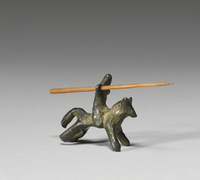 Toy Mounted Knight
 Small bonze toy depicting a mounted knight on horseback holding a lance. The body of the rider and horse is bronze and the lance is wooden. The rider and horse are positioned as if they are actively riding in a joust.
-
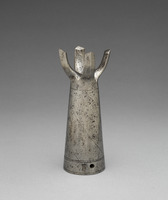 Lance Head for the Joust of Peace
 This is a four pronged blunted steel lance tip used in the Joust of Peace. The Joust of Peace took place in tournaments that were intended to be entertainment and displays of skill. The blunted lance heads caused less damage and often resulted in a broken or shattered lance with minimal damage to the knight and their armor.
-
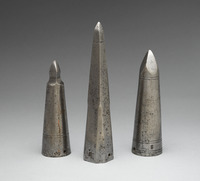 Lance Head for the Joust of War
 Pointed lance heads made of steel. These lance heads were used in the Jousts of War. The Joust of War was a medieval jousting tournament where knights participated with the intention of killing or injuring their enemies. This was often used to settle disputes, between knights who were currently at war or to avoid outright conflicts between countries.
-
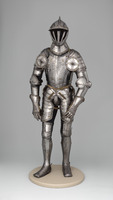 Armor of Emperor Ferdinand I (1503–1564)
 This full suit of armor for Ferdinand I, the Holy Roman Emperor and King of Bohemia, Hungry, and Croatia, is incredibly ornate with engravings on every piece. The chest piece or breastplate has imagery of the Virgin and Child. The backplate is decorated with crossed staves and firesteels and the insignia of the Order of the Golden Fleece which was an elite chivalric society in the medieval period.
-
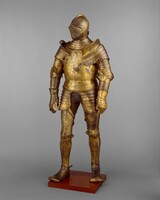 Armor Garniture, Probably of King Henry VIII of England (reigned 1509–47)
 Large suit of armor probably designed for King Henry VIII (reigned 1509–47). This suit of armor is gilded in gold over all surfaces in a rich display of wealth and prestige. Many pieces of the armor have the ability to be exchanged with different styles to fit the field or tournament settings. Probably made for King Henry VIII of England by French ambassador François de La Tour d’Auvergne, viscount of Turenne.
-
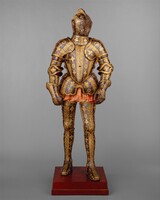 Armor Garniture of George Clifford (1558–1605), Third Earl of Cumberland
 Full suit of armor intricately decorated with the Tudor Rose and the fleur-de-lis. Gold engravings cover the armor from helmet to boots. This armor was designed for George Clifford (1558–1605) the Queen's Champion. This armor would have been used for both the field and tournaments in the later stages of jousting and equestrian chivalric sport.
-
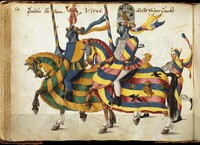 Album of Tournaments and Parades in Nuremberg
 Colorfully illustrated early modern book depicting imagery of the tournament. Knights are colorfully adorned. Fully armored knights on horseback with extravagant items as crest for their helms, including a birdcage with bird, statues, and other adornments. The horses are covered in shaffrons that are multicolored. The knights are in parade as as show before the Joust of Peace.
-
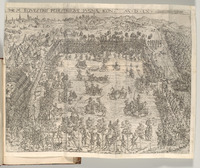 Tournament Book of Knightly Acts (Thurnier Buech Warhafftiger Ritterlicher Thaten)
 Book depicting various illustrations of the medieval tournament. Images of the tournament showing the audience a other participants viewing knightly and chivalric acts such as martial combat, jousting, and other activities. Images of a castle courtyard filled with jousting and other elements of the tournament.
-
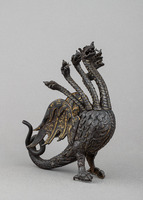 Helmet Crest for the Burgonet of Sforza Pallavicino (1519–1585)
 Seven headed hydra that was used as a crest for a helmet and a badge of identity in the medieval tournament. A demonstration of the pageantry involved in the medieval period.
-
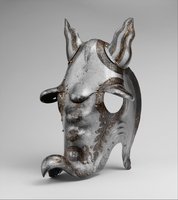 Shaffron (Horse's Head Defense) of Henry II of France, When Dauphin
 Horse head armor called a shaffron in the shape of a dragon head. Silver with gold inlay. Used to protect the horse from damage by opponent lance or the shards from broken lances.
-
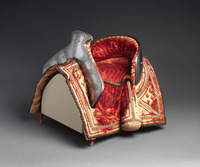 Set of Saddle Steels
 Italian saddle for horse and rider used in the medieval tournament. Highly decorated and plated with steel for the protection of the knight during the joust. Saddle has steel plates on the front and in the rear.
-
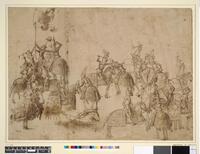 Drawing
 Scene of the early tournament or melee. Knights on horseback are engaged in martial competition. A flag is being raised and a fallen rider is at the center.
-
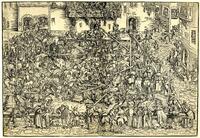 The First Tournament
 Image of the early medieval tournament. Lists used for jousting are in the center of a town square, combatants are engaged in a mass melee or mock battle. Spectators surround the knights viewing the entertainment. Shields of Saxon design are attached to a balcony of the surrounding buildings.
-
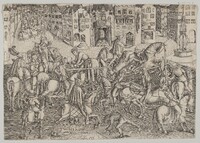 The Tournament
 Depiction of an early medieval tournament or melee. Knights are engaged in a mock battle and other martial competitions. Tournament is in the center of a town square with spectators looking on from a balcony in the center of the image, possibly the patrons who initiated the tournament.
-
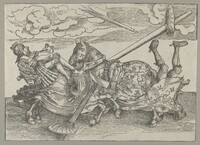 The German Tournament: "Anzogen-Rennen"
 Two knights at the lists or joust. The knights have collided and broken the list. Both knights have fallen off of their horses. The knight on the right has fallen head first.
-
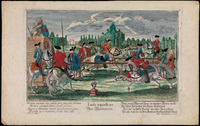 Ludi equestres. Das Thurnieren (The Tournament)
 Eighteenth century upper class riders are engaging in horsemanship and martial games. They are using the lance to try and catch the point of the lance into a ring. The game or competition is called the course of the ring. The riders are in between wooden beams similar to a list used in the joust. This is evidence of the lasting legacy of the medieval tournament and the continuum of medieval sport.
-
 The Joust
 Descrition of how a knight participates in the medieval tournament activity of the tilt or joust.