|
Parks & Recreation Management Program Annual Assessment Report -February 2014- |
 |
|
Parks & Recreation Management Program Annual Assessment Report -February 2014- |
|
Northern Arizona University
University Assessment Committee
Annual Assessment Report Feedback
General Information
Academic Unit: Parks and Recreation Management
Degree Program(s) and Emphases (if applicable): BS in Parks and Recreation Management
Date of submission of report to UAC by Academic Unit: 02/07/2014
Date of UAC feedback to Academic Unit: 04/03/2014
UAC Feedback Providers’ Contact Information
|
|
Reviewer |
Reviewer |
Reviewer |
Add as necessary |
|
Name |
Dierdra Bycura |
Sue Pieper |
|
|
|
|
Dierdra.bycura@nau.edu |
Sue.pieper@nau.edu |
|
|
|
Phone |
928.523.5018 |
928.523.1502 |
|
|
|
In general, the report sent in should be praised for the following: |
|
· Clearly explaining changes to the assessment strategy · Effectively using a curriculum map to target courses for assessment · Clearly reporting all assessment findings by student learning outcome and including charts displaying results
|
|
General recommendations and next steps for action: |
|
· Check to be sure your assessment measures are aligned with the modified COAPRT student learning outcomes. · Consider further refining your curriculum map by identifying the extent to which program student learning outcomes are introduced, reinforced, or mastered in each course in order to better examine gaps and redundancies in your curriculum.
·
Think
about using the questions we’ve posed as guides to further evaluate your
findings and make any needed recommendations for curriculum, learning
design, and assessment. |
Phase I: Mission, Student Learning Outcomes, And Assessment Strategy
|
1. Reviewer Response: Mission |
|
Notes:
|
|
2. Reviewer Response: Student Learning Outcomes |
|
Notes:
|
|
3. Reviewer Response: Curriculum Map |
|
Notes:
|
|
4. Reviewer Response: Assessment Question(s) |
|
Notes:
|
|
5. Reviewer Response: Assessment Design |
|
Notes:
|
|
6. Reviewer Response: Assessment Measures |
|
Notes:
|
|
7. Reviewer Response: Assessment Strategy |
|
Notes:
|
Phase II: Data Collection
|
8. Reviewer Response: Assessment Strategy Modifications (if any) |
|
How, more specifically, were student learning outcomes changed by COAPRT? Did these changes affect the alignment between the student learning outcomes and your assessment measures? If so, in what ways? Keep in mind that misalignment between outcomes and measures could affect the validity of your use and interpretation of assessment results. You have effectively used your curriculum map to target courses for embedded assessment. It would be helpful for readers to include the names of the assignments used for assessment in the targeted courses as part of your curriculum map. It would also be helpful to include the title of each course. How
can you further examine the large number of courses (overlap) that
appear to address the same learning outcome (e.g., 7.01)? You might
begin by identifying the extent to which program student learning
outcomes are introduced, reinforced, or mastered in each course.
|
Phase III: Summary of Findings, Interpretations, and Recommendations
|
9. Reviewer Response: Findings, Interpretations, Implications |
|
How can you further evaluate your findings? For example, how are the results from three different assignments/rubrics assessing student learning outcome 7.03 similar? How are they different? Why? We observed, for instance, that some rubrics were more clearly aligned to student learning outcomes—focusing on content quality-- than others. More specifically, some of your assessments include a rubric that has a significant proportion of items/points that are scored on things like formatting, organization, and writing mechanics. This could account for some of the differences in students’ grades on assignments/rubrics.
Your standard for student learning of the outcomes is 70% of students
receiving a 70% or better on the assignments/rubrics. Is this your
standard or COAPRT’s? Are faculty satisfied with the percent of student
receiving a 70% or better hovering around 70%? What about the other 30%
of students who received below 70%? How can you improve these students’
learning in the program? |
|
10. Reviewer Response: Curricular/ Learning Design Modifications |
|
Notes: Curricular/learning design modifications are minimally addressed, although you state a commitment to “using this assessment data as a means of understanding, documenting, and improving the quality of student learning.”
We
suggest using the questions above as guides to further evaluate your
findings and make any needed recommendations for curriculum, learning
design, and assessment. |
|
11. Reviewer Response: Assessment Improvements or Future Assessment Questions |
|
Notes: See response above.
|
|
12. Reviewer Response: Dissemination of Findings |
|
Notes: Assessment findings are disseminated and discussed among program
faculty. How are you disseminating results to students and other
stakeholders? You might highlight assessment accomplishments, for
example, on your program website for all to see. |
Northern Arizona University
University Assessment Committee
Annual Assessment Report
General Information About Your Program:
Academic Unit: Parks and Recreation Management
Degree Program(s) and Emphases (if applicable): BS in Parks & Recreation Management
Date: Submission of Report
Report Writers’ Contact Information
|
|
Primary Contact |
Secondary Contact |
Others Involved in Writing Report |
|
Name: |
Judy Montoya |
Tom Paradis |
|
|
e-mail: |
Judith.Montoya@nau.edu |
Thomas.Paradis@nau.edu |
|
|
Phone Number |
523-8523 |
523-5853 |
|
Phase II: Data Collection
8. Provide a Status Report on Data Collection and Assessment Strategy Modifications by Completing the Following Table Identifying Actual Implementation of Assessment:
|
|
Data Collection |
Data Analysis |
||
|
Assessment Tool |
Who was responsible for collecting the data |
When and/or where data collection took place |
Who was responsible for data analysis |
When data analysis took place |
|
The data for evaluating the measures used were extracted from individual Blackboard Learn Course shells from Fall 2012 and Spring 2013 courses where all evaluation scores of assignment assessments are retained.
|
Judy Montoya with help from GPR office staff |
Data collection took place during the Fall 2013 semester during the months of September, October, and November. |
Judy Montoya |
November & December 2013. |
If changes were made to your Assessment Strategy, describe the changes and briefly explain why the assessment strategy was modified
|
Between the time of our Phase I submission and Phase II Data Collection, changes were implemented in the Learning Outcome requirements set forth my our program accrediting agency, The National Recreation and Park Association Council on Accreditation for Parks, Recreation, Tourism and Related Professions (COAPRT). Therefore data collection and analyses were conducted on the updated program learning outcomes (Section 7.0 Series) in conjunction with our self-study and in preparation for our re-accreditation application process. The following Learning Outcomes were assessed: FOUNDATIONS 7.01 Students graduating from the program shall demonstrate the following entry-level knowledge: a) the nature and scope of the relevant park, recreation, tourism or related professions and their associated industries; b) techniques and processes used by professionals and workers in these industries; and c) the foundation of the profession in history, science and philosophy. PROVISIONS OF SERVICES AND EXPERIENCES 7.02 Students graduating from the program shall be able to demonstrate the ability to design, implement, and evaluate services that facilitate targeted human experiences and that embrace personal and cultural dimensions of diversity. MANAGEMENT AND ADMINISTRATION 7.03 Students graduating from the program shall be able to demonstrate entry-level knowledge about operations and strategic management/administration in parks, recreation, tourism and/or related professions. 7.04 Students graduating from the program shall demonstrate, through a comprehensive internship of not less than 400 clock hours and no fewer than 10 weeks, the potential to succeed as professionals at supervisory or higher levels in park, recreation, tourism, or related organizations. Through the process of curriculum mapping by the entire PRM faculty we were able to identify which core courses and course assignment/learning outcomes would best demonstrate evidence of compliance with the required COAPRT learning outcomes. Our mapping indicated overlap of some courses but the final courses were selected based on strength and direct correlation to the COAPRT learning outcomes.
PRM Core Curriculum Map COAPRT 7.00 Series
** Please list the assignments/assessments that best convey the evidence of learning outcomes (7.01-04) for each of your classes listed and return to me. Yellow: NRPA accreditation and NAU assessment
|
|||||||||||||||||||||||||||||||||||||||||||||||||||||||||||||||||||||||||||||||||||||||||||||||||||||||||||||||||||||
Phase III Summary of Findings, Interpretations, and Recommendations
|
Information corresponding with the following three items 9, 10, and 11 is included below.
|
9. Describe Findings, Interpretations, and Implications
10. Describe recommendations for Curricular/ Learning Design Modifications
11. Describe recommendations for Assessment Improvements or Next Assessment Questions
Section 7.0 Learning Outcomes
7.0 Learning Outcomes
FOUNDATIONS
7.01 Students graduating from the program shall demonstrate the following entry-level knowledge: a) the nature and scope of the relevant park, recreation, tourism or related professions and their associated industries; b) techniques and processes used by professionals and workers in these industries; and c) the foundation of the profession in history, science and philosophy.
7.01.01 - Evidence of Compliance
We assess Learning Outcome 7.01, a., b., and c. using direct measures in the following ways:
PRM 220 - Introduction to Parks and Recreation Management: (see Appendix PRM 220 Introduction to Parks and Recreation Management)
· Professional Association Assignment – Grading Rubric (see Appendix XXX); Learning Outcomes: The students will become familiar with a variety of recreational professional associations; understand the purpose of a mission statement within a professional association; Identify vocational benefits in relationship to membership within a professional association; and identify the core structural components of a professional association.
· Leisure Service Inventory Assignment – Grading Rubric (see Appendix YYY); Learning Outcomes: The students will cultivate understanding around the structural organization of all branches of parks and recreation service systems; identify the unique approaches, concerns, techniques, and responsibilities of each branch of parks and recreation service systems; and become familiar with the historical evolution of each branch of parks and recreation service systems.
· Historical Profile Assignment – Grading Rubric (see Appendix ZZZ); Learning Outcomes: The students will think critically about the history of parks and recreation in relationship to a prominent figure within that history; identify the philosophy of a historical figure in relationship to the leisure philosophy of the historical era in which they lived; and connect theories on leisure, recreational wellness benefits, and leisure motivations to the behavior and unique approach of a chosen historical figure within the historical context of parks and recreation.
· Personal and Professional Philosophy Assignment – Grading Rubric (see Appendix AAAA); Learning Outcomes: The students will understand a variety of modern and ancient philosophical approaches to recreation and leisure; connect life experiences and individual values to core philosophical concepts in relationship to recreation and leisure; and foster the ability to see multiple.
7.01.02 - Demonstration of Quality Assessment Measures Used
The data for evaluating the measures used were extracted from individual Blackboard Learn Course shells from Fall 2012 and Spring 2013 courses where all evaluation scores of assignment assessments are retained.
7.01.03 - Demonstration of Results Indicating Achievement of Learning Outcome
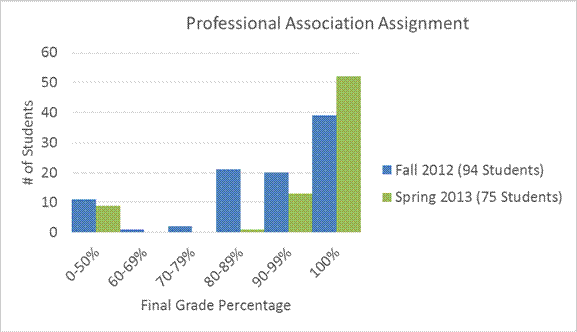
|
% receiving 70% or better (Target 70%) |
|
|
Fall 2012 - 82 Students (87%) |
Spring 2013 - 66 Students (88%) |
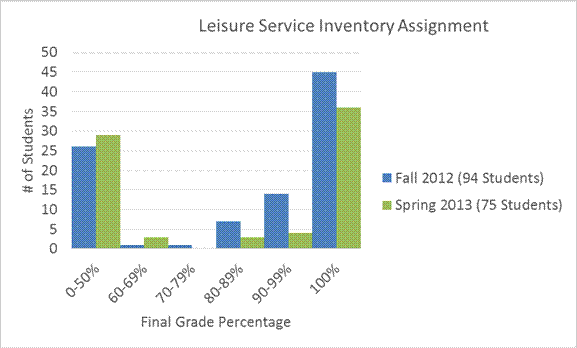
|
% receiving 70% or better (Target 70%) |
|
|
Fall 2012 - 67 Students (71%) |
Spring 2013 - 43 Students (57%) |
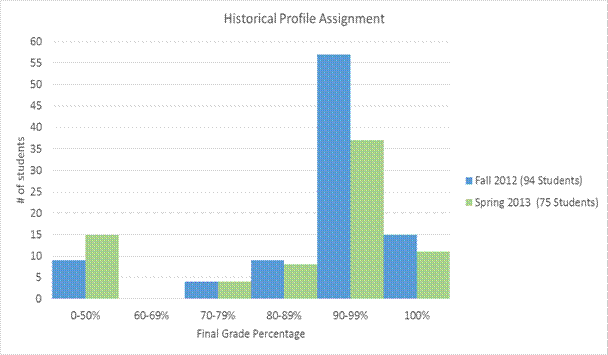
|
% receiving 70% or better (Target 70%) |
|
|
Fall 2012 - 66 Students (69%) |
Spring 2013 - 54 Students (70%) |
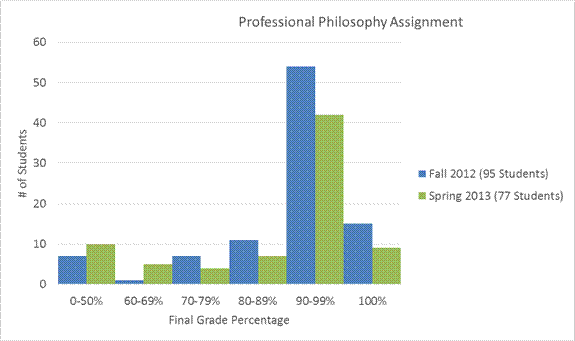
|
% receiving 70% or better (Target 70%) |
|
|
Fall 2012 - 66 Students (69%) |
Spring 2013 - 52 Students (69%) |
Overall, the assessment data supports the conclusion that students in the PRM Program are learning and applying foundational, entry-level knowledge of the scope of the profession and associated industries; techniques and processes used by professionals; and philosophical, historical, and scientific foundations of the profession. With the exception of the Leisure Service Inventory Assignment in spring 2013, all other outcome measures were met or were within one percentage point of our 70 percent target.
7.01.04 – Demonstration of Using Data for Continuous Program Improvement
Regarding the measures found in the leisure Service Inventory for Spring 13, a point distribution adjustment occurred, making the assignment worth half as much as it did in the previous semester. This was performed by the instructor as a means to create more consistency among low-stakes assignments as the class was being re-developed during that time. The point distribution for the assignment is now stabilized and designated as a low-stakes assignment. This will allow more accurate measurability in future data collections regarding student performance.
PROVISIONS OF SERVICES AND EXPERIENCES
7.02 Students graduating from the program shall be able to demonstrate the ability to design, implement, and evaluate services that facilitate targeted human experiences and that embrace personal and cultural dimensions of diversity.
7.02.01 - Evidence of Compliance
We assess Learning Outcome 7.02 using direct measures in the following ways:
PRM 275 – Program Planning: (see Appendix PRM 275 Program Planning)
· Recreation Program Proposal Assignment – Grading Rubric (see Appendix BBBB); Learning Outcome – Students will work collaboratively in small groups to develop a comprehensive Recreation Program Plan proposal where they can integrate their personal creativity with the theoretical concepts of program design elements into a synthesized workable professional-level program proposal.
· Community Volunteer Assignment – Grading Rubric (see Appendix CCCC); Learning Outcomes – Students will network and collaborate with a recreation professional in their respective community who is working to deliver leisure/recreational programming and will gain valuable experience in observing and implementation of an established program, event, or activity; and through a critical review/reporting process reflect on details of the program, event, or activity that they have assisted in.
PRM 326 – Inclusive Recreation: (see Appendix PRM 326 Inclusive Recreation)
· Recreation Inclusion Plan – Grading Rubric (see Appendix DDDD); Students will design an inclusion plan for a recreation agency or program to include people with disabilities including a general introduction and demonstrate application of physical integration, social integration, right to self-determination and age appropriate experiences.
· Accessibility Assignment - Accessibility Survey – Grading Rubric (see Appendix EEEE); Learning Outcome - Students will demonstrate and apply knowledge of ADA and Universal Design by choosing one business or public building/facility to evaluate for accessibility using the accessibility survey provided and complete a reflective summary of their findings.
7.02.02 - Demonstration of Quality Assessment Measures Used
The data for evaluating the measures used were extracted from individual Blackboard Learn Course shells from Fall 2012 and Spring 2013 courses where all evaluation scores of assignment assessments are retained.
7.02.03 - Demonstration of Results Indicating Achievement of Learning Outcome
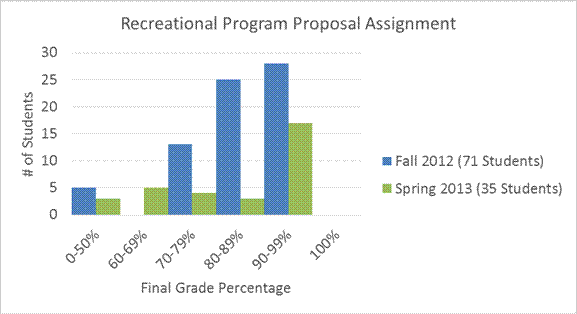
|
% receiving 70% or better (Target 70%) |
|
|
Fall 2012 - 66 Students (93%) |
Spring 2013 – 24 Students (69%) |
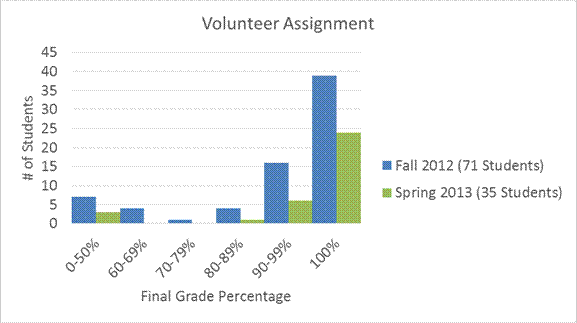
|
% receiving 70% or better (Target 70%) |
|
|
Fall 2012 - 60 Students (85%) |
Spring 2013 - 31 Students (89%) |
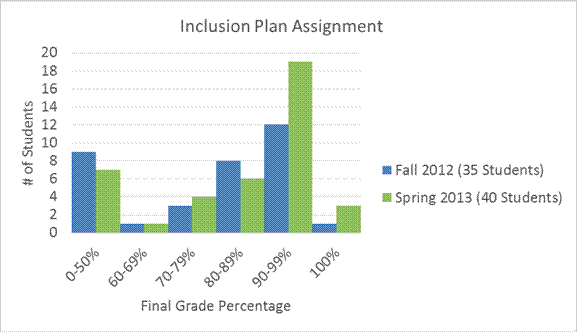
|
% receiving 70% or better (Target 70%) |
|
|
Fall 2012 - 24 Students (69%) |
Spring 2013 - 32 Students (80%) |

|
% receiving 70% or better (Target 70%) |
|
|
Fall 2012 - 29 Students (83%) |
Spring 2013 - 37 Students (93%) |
Overall, the assessment data supports the conclusion that students in the PRM Program are learning how to design, implement, and evaluate services that facilitate targeted human experiences and that embrace personal and cultural dimensions of diversity. All outcome measures were met or were within one percentage point of our 70 percent target.
7.02.04 – Demonstration of Using Data for Continuous Program Improvement
The data analysis associated with this Learning Outcome will be used to guide and support our faculty with regard to student achievement and performance in relations to academic goals for the purpose of improving student learning and development in the PRM Program. We are committed to using this assessment data as a means of understanding, documenting and improving the quality of student learning.
MANAGEMENT AND ADMINISTRATION
7.03 Students graduating from the program shall be able to demonstrate entry-level knowledge about operations and strategic management/administration in parks, recreation, tourism and/or related professions.
7.03.01 - Evidence of Compliance
We assess Learning Outcome 7.03 using direct measures in the following ways:
PRM 426 – Parks & Recreation Administration and Finance: (see Appendix PRM 426 Parks and Recreation Administration and Finance)
· Mission Statement/Goals & Objectives Assignment - Grading Rubric (see Appendix FFFF); Learning Outcome - Students will demonstrate the ability to correctly develop a set of goals (5) and objectives (10) for a municipal recreation center.
· Staffing Plan Assignment - Grading Rubric (see Appendix GGGG); Learning Outcome - Students will develop a staffing plan represented as an organizational chart for their municipal recreation center.
· Budget Assignment - Grading Rubric (see Appendix HHHH); Learning Outcomes - Students will demonstrate a working knowledge of developing an operations and maintenance line item budget for their municipal recreation center including projected revenues and expenses. They will also develop a capital budget for the same municipal recreation center.
7.03.02 - Demonstration of Quality Assessment Measures Used
The data for evaluating the measures used were extracted from individual Blackboard Learn Course shells from Fall 2012 and Spring 2013 courses where all evaluation scores of assignment assessments are retained.
7.03.03 - Demonstration of Results Indicating Achievement of Learning Outcome

|
% receiving 70% or better (Target 70%) |
|
|
Fall 2012 - 45 Students (78%) |
Spring 2013 - 47 Students (80%) |

|
% receiving 70% or better (Target 70%) |
|
|
Fall 2012 - 40 Students (69%) |
Spring 2013 - 47 Students (80%) |

|
% receiving 70% or better (Target 70%) |
|
|
Fall 2012 - 31 Students (53%) |
Spring 2013 - 27 Students (46%) |
Overall, the assessment data supports the conclusion that students in the PRM Program are learning entry-level knowledge about operations and strategic management/administration in parks, recreation, tourism and/or related professions. With the exception of the Budget Assignment, all other outcome measures were met or were within one percentage point of our 70 percent target.
7.03.04 – Demonstration of Using Data for Continuous Program Improvement
To address the outcome of the Budget assignment of less than the 70% target, additional resource material and budgeting information has been added to the Budget assignment to assist students in improving the average scores to 70% or above.
7.04 Students graduating from the program shall demonstrate, through a comprehensive internship of not less than 400 clock hours and no fewer than 10 weeks, the potential to succeed as professionals at supervisory or higher levels in park, recreation, tourism, or related organizations.
7.04.01 - Evidence of Compliance
We assess Learning Outcome 7.04 using direct measures in the following ways:
PRM 498C – Senior Seminar: (see PRM 498C Senior Seminar)
· Cover Letter/Resume/References Assignment – Grading Rubric (see Appendix IIII); Learning Outcome – Students will acquire knowledge necessary to develop a professional cover letter and resume with reference list and apply this knowledge by preparing a professional cover letter and resume with references to be used for their mock interview assignment.
· Mock Interview Assignment – Mock Interview Evaluation – Self Evaluation (see Appendix JJJJ); Learning Outcome – Students will gain practical knowledge and professional interviewing skills by participating in a mock interview with a current recreation/leisure professional in the field.
PRM 408 – Internship in Parks & Recreation Management: (see Appendix PRM 408 Internship in Parks and Recreation Management); Learning Outcomes – Students will increase their knowledge, skills, and experience related to the Parks and Recreation Management profession through participating in a “real world” experiential high quality work experience. Students will develop and expand their affiliation and networking with professionals in the field.
· Internship Final Supervisor Evaluation (see Appendix KKKK)
· Internship Midway Supervisor Evaluation (see Appendix LLLL)
· Internship Student Self-Evaluation (see Appendix MMMM)
7.04.02 - Demonstration of Quality Assessment Measures Used
The data for evaluating the measures used were extracted from individual Blackboard Learn Course shells from Fall 2012 and Spring 2013 courses where all evaluation scores of assignment assessments are retained.
7.04.03 - Demonstration of Results Indicating Achievement of Learning Outcome

|
% receiving 70% or better (Target 70%) |
|
|
Fall 2012 – 58 Students (94%) |
Spring 2013 - 42 Students (98%) |

|
% receiving 70% or better (Target 70%) |
|
|
Fall 2012 – 52 Students (85%) |
Spring 2013 - 38 Students (84%) |

|
% Completing Internship by end of term (Target 70%) |
||
|
Fall 2012 – 18 Students (86%) |
Spring 2013 – 28 Students (85%) |
Summer 2013 – 20 Students (56%) |
Students in the PRM Program must enroll in PRM 498C Senior Seminar in their final semester prior to enrolling and completing their PRM 408 Internship. The Internship is a 12 credit hour course consisting of a total of 600 clock hours which can be completed as a 15 week course in fall or spring or a 12 week course in summer.
In addition, in order to enable them to be successful in acquiring an Internship position they also develop a Cover Letter, Resume, and Reference List and participate in a Mock Interview with a Professional in parks and recreation, tourism, or related organization while enrolled in PRM 498C Senior Seminar. We feel this enhances their potential to succeed as professionals at supervisory or higher levels in park, recreation, tourism, or related organizations.
Overall, the assessment data supports the conclusion that students in the PRM Program are successfully completing a comprehensive internship of 600 clock hours.
7.04.04 – Demonstration of Using Data for Continuous Program Improvement
All outcome measures met our 70 percent target with the exception of the Summer Internship 2013. Because the summer session is only 12 instead of 16 weeks, the students are given the option of taking an Incomplete (I) grade at the close of the session if more time is required to complete the 600 hours. This could account for the lower percentage of completed hours up to this point in time. We will continue to monitor the completion rate of the summer session students.
12. Describe recommendations for Dissemination of Findings
|
All findings were disseminated to Parks and Recreation Management faculty members via email and then reviewed and discussed in several consequent faculty meetings. All faculty members have agreed to complete continuous program improvement reports for each course taught at the end of each semester so we can continue to monitor our progress and make necessary changes when needed. Once our accreditation site visit is complete in mid-March 2014 and we receive feedback we will develop an action plan to address any needed curriculum improvements. |
[PRM Home]
 Northern
Arizona University, Parks & Recreation Mgmt. ALL RIGHTS RESERVED