-
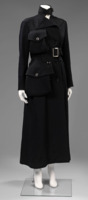 Coat
Coat This black coat, made by fashion designer Yohji Yamamoto, is a woman's outdoor coat. Featuring two long external pockets, the coat is made from black wool gabardine. Down the front of the coat lies a row of top-to-bottom buttons, and wrapped around the waist is a belt, to make the coat extra secure and give some shape to the design. These pockets and warm material make this coat a functional and fashionable masterpiece.
-
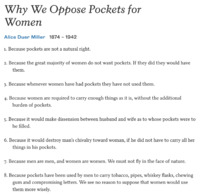 Satirical article by Alice Duer Miller published in the New York Tribune, 1915.
 Satirical 1915 article by American poet Alice Duer Miller from her column “Are Women People?” which ran in the New York Tribune newspaper between 1915 to 1917. In this article, pockets for women are used as a symbolic representation or metaphor for votes for women. But the use of pockets is also humorous and satirical as women’s clothing with pockets, worn by many modern women who actively advocated for the vote, also became emblematic of suffragette attire and were widely used in negative political caricatures of suffragettes.
-
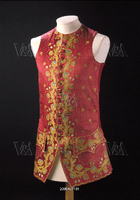 Brocaded Crimson & Gold Silk Design
 This is a man's waistcoat that originated in Britain between 1760-1770. It features a rounded neck made from red satin that is brocaded with silver and yellow thread. It is a wovven to be a fitted and functional item of clothing while being fashionable with its stunning embroidery. The waistcoat aslo features two pockets on opposite sides of the buttons down the front of the coat.
-
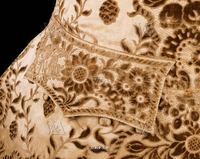 Men’s Waistcoat Pocket Detail (covered flap for pocket)
 Detail of the exterior pocket flap on a men’s waistcoat. The pockets on this ornate velvet men’s waistcoat from the mid-18th Century reveal how the design of sewn-in pockets were integrated into men’s clothing as part of the aesthetic, fashion, and styling of menswear. This contrasts with women’s clothing, which did not have sewn-in or integrated pockets.
-
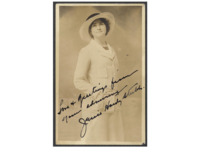 Mrs. Jessie Hardy Stubbs, later Mrs. Benton Mackaye, also known as "Betty" MacKaye.
 A picture postcard portrait of Jessie Hardy Stubbs (later MacKaye) who is described as wearing “a light colored suit, hand in pocket, wearing hat.” The postcard is signed “Love and greetings from your admiring Jessie Hardy Stubbs”. Records indicate it was sent by Jessie Hardy Stubbs and addressed to Alice Paul in N. Jersey with a postmark of December 22, 1913. Noted to be a member of the Advisory Council, National Press Chairman of the Congressional Union, and active in the suffrage movements in Illinois and Washington, D.C., in this image Jessie Hardy Stubbs is shown with her hands in her pockets, adopting a stance connected to suffragettes. She is also wearing clothing similar to the popularized “Suffragette Suit” which was purposefully designed with pockets not previously integrated into women’s clothing.
-
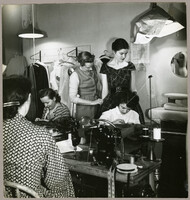 Fashion Designer Claire McCardell Fitting a Dress to a Model in the Workroom
 American fashion designer Claire McCardell (1905-1958) fitting one of her dresses to a model in a workroom alongside some of the women employed by McCardell making garments. McCardell is known as the first designer to design and produce affordable (off-the-rack) women’s clothing with pockets. While Gabrielle ‘Coco’ Chanel was known for producing women’s clothes with pockets and for popularizing pants (also with pockets) for women, Chanel’s clothes were expensive and generally only worn by the rich and famous. In contrast, McCardell pioneered casual and comfortable sportswear for women, designing affordable women’s clothing that was fashionable, stylish, practical and comfortable.
-
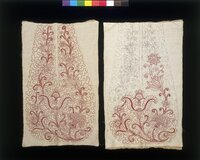 Unfinished, Partially Embroidered Pocket Fronts
 Partially embroidered, this in progress tie-on pocket shows an ink design that was probably hand-drawn onto linen that was being embroidered. From the Hannah Downes collection of needlework that consists of the work of four generations of British women, the pocket has been identified as the work of Downes daughter, Hannah Haines, between 1718-1720. Once the embroidery had been completed, the pocket would have been cut out, lined and sewn to the back piece. The edges would then be bound and the ties attached. Tie-on pockets were widely used though the 18th and 19th Centuries as pockets were not sewn into women’s clothing. Often made at home from a variety of materials, the quality and design of tie-on pockets not only reflected the wealth and class of their owner, but also fashion and aesthetics. Worn under the outer dress and skirts, tied around the waist, they were accessed through openings in the outer garment.
-
 #GiveUsPocketsOrGiveUsDeath
 The #GiveUsPocketsOrGiveUsDeath post on X (formerly known as Twitter) represents the appropriation of the famous quote from Patrick Henry, “Give me liberty or give me death”, that represents the determination and significance of the American fight for independence. The adoption of this phrasing is intended to emphasize the significance of women’s advocacy for (functional) pockets in their clothing. Also present on other social media sites, this social media advocacy represents the continued discontent with the lack of pockets or limited functional pockets typically integrated into women’s clothing.
-
 #WeWantPockets
 The #WeWantPockets post on X (formerly known as Twitter) was reported as gaining momentum on social media by the BBC in September, 2025. Also present on other social media sites, this social media advocacy represents the continued discontent with the lack of pockets or limited functional pockets typically integrated into women’s clothing.
-
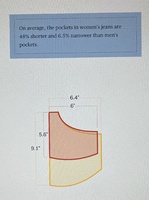 Average Size of Men’s and Women’s Front Pockets in the US Top 20 Jeans Brands
 This image displays a representation of the average size of men’s jeans front pocket and women’s jeans front pocket from a study of pockets in the top 20 jeans brands in the US from 2018. The women’s front pockets are represented in red, the men’s pockets in yellow. The accompanying figures represent the difference numerically to further evidence the finding that men’s jean pockets are substantially larger than women’s. The authors of the study concluded that, on average, pockets in women’s jeans were 48% shorter and 6.5% narrower than in men’s jeans.
-
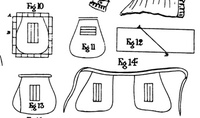 Illustrations for Home-Made Women’s Pockets
 Selection of illustrations as part of a guide to making a range of different women’s pockets for wearing under dresses from the book “The Workwoman’s Guide” written in 1838 by “A Lady”. Part of a larger plate of illustrations for a range of items of clothing (Plate 10, p.64), the figures shown here (Figures 10-14) are illustrations for pockets to accompany written instructions (p.73). The illustrations represent descriptions provided on different ways to align the entry to the pockets (Figures 10 and 11).
-
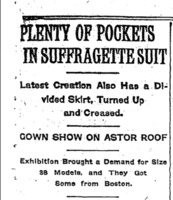 Plenty of Pockets in Suffragette Suit
 Headline and opening content of a New York Times article about the new “Suffragette Suit” with plenty of integrated pockets, in contrast to most women’s clothes at that time which typically had no pockets. Referred to as the Suffragette Suit because of its association with the clothing worn (and popularized) by women pushing gender boundaries related to women’s equality and the right for women to vote. One aspect of this gender-boundary pushing was wearing clothing with features previously restricted to men, notably pockets and a divided skirt that allowed contested activities for women, like riding a bicycle. This suit became very popular with fashionable women seeking both function and fashion in a modern form.
-
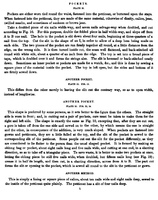 Description for Home-Made Women’s Pockets
 Written instructions on how to make a range of different women’s pockets for wearing under dresses from the book “The Workwoman’s Guide” written in 1838 by “A Lady”. The text provides details for the production of these variations, including descriptions on how to wear and/or attach them, with illustrations (Figures 10-14) for the pockets provided (see Illustrations for making home-made women’s pockets for images from the accompanying plate). The description includes different ways to align the entry to the pockets and a set of pockets that is stated to be preferred by some “as it sets better to the figure than the others.” (p. 73).
-
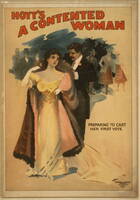 Hoyt's a Contented Woman; Contented Woman
 Theatrical poster (one of many) for Hoyt’s 1897 play A Contented Woman. The play concerned societal differences contrasting the contented housewife with the discontented suffragette. Performed on Broadway, New York, the play was promoted through a variety of theatrical posters using a wide range of images of women and men to represent the various themes and types of people made identifiable through clothing, posture, etc. In this specific poster the central, forefronted couple consists of an elegant, fashionable and traditionally feminine ‘contented woman’ with her (assumed) husband who is following the traditional gender etiquette by helping her with coat. Their demeanour and clothing suggests a happy, wealthy couple, while the statement alongside them indicates a supportive and cooperative partnership as the husband assists in ‘preparing to cast her first vote’. The figure and clothing of this woman and her helpful companion sit in contrast to the figures who can be seen in the background, especially the suffragette women shown behind to the right with their shorter skirts and more masculinized hats and jackets, standing with their hands in their pockets.
-
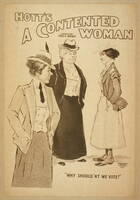 Hoyt's a Contented Woman; Contented Woman
 Theatrical poster (one of many) for Hoyt’s 1897 play A Contented Woman. The play concerned societal differences contrasting the contented housewife with the discontented suffragette. Performed on Broadway, New York, the play was promoted through a variety of theatrical posters that include a wide range of images of women and men to represent the various themes and types of people made identifiable through clothing, posture, etc. In this specific poster three “discontented” suffragettes are represented, identifiable through their sour facial expressions and their style of clothing which includes pockets that allow them to stand with their hands in their pockets. Such clothing and standing with hands in pockets was considered masculine by many at this time, but also as a powerful stance by women advocating for the vote. The written quotation representing their position “Why shouldn’t we vote?” at the bottom of the image further identifies them as suffragettes and their discontent regarding their lack of a right to vote.
-
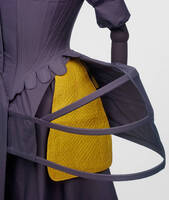 Pocket Displayed on a Mannequin
 Demonstration of how original quilted silk tie on women’s pockets would have been worn under a women’s dress. A mannequin wearing a dress with the front section of the skirt removed reveals the pocket underneath to illustrate how pockets were worn under garments. The pockets were accessed through an opening in the outer skirt.
-
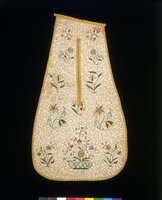 Pair of Pockets
 Tie on pockets. This single pocket is believed to have been part of a pair of pockets influenced with embroidery that is influenced by Indian designs. While the simple functional design of pockets remain, for women with the financial means and status pockets became products made from more expensive materials and incorporated aesthetic designs and adornments reflecting the dominant fashions. The angle of the entry to the pocket in relation to the waist suggests that, when worn, the entry to the pocket would have been angled to facilitate access if worn on a specific side.
-
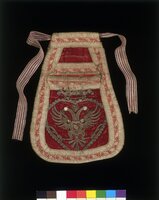 Pocket
 Tie on pocket with embroidery. Pockets were often made from old clothing or incorporated pieces of other clothing, and these pockets integrate materials from different dates.
Towards the end of the 19th Century wealthier fashionable women began to have pockets sewn into the seams of their dresses. But children, older women and those from the poorer classes continued to wear tie on pockets.
-
 Pair of Pockets
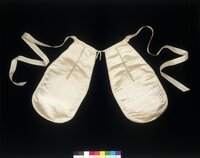
 Pair of women’s pockets made of white silk satin, bound with white silk twill ribbon. The tie is a ribbon of white silk taffeta, which has been re-tied between the pockets after breaking. According to the Victoria and Albert Museum, the material combined with the lack of embroidery have made these pockets hard to date. Equally, although quite plain, the material means they are considered as attractive as embroidered examples.
-
 Pair of Pockets
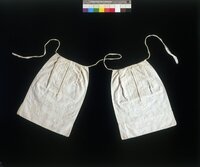
 Pair of women’s tie on pockets with a simple embroidered design. Pockets were tied around the waist under the skirt or dress and accessed through an opening in the outer skirt. Tie on pockets were across all classes of society and were often large and spacious to maximize capacity and function for keeping useful, valuable, and private possessions and objects close to the person.