Introduction
Women’s Pockets: Function, Fashion, & Politics
This exhibit invites all to embark on an educational journey about how pockets hold more than just objects. Through the history of pockets displayed in this exhibit, one will gain an understanding of why pockets are significant for the growth of female empowerment.
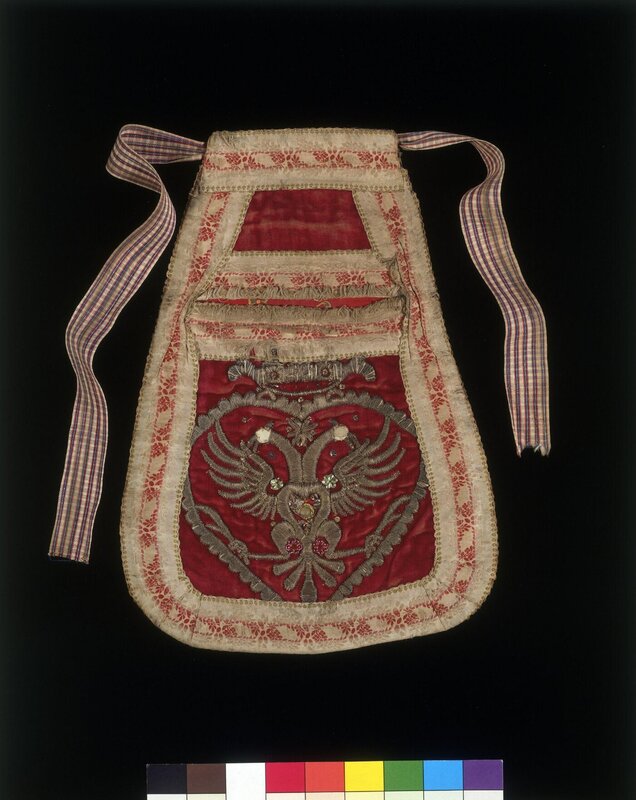
Pocket. Victoria and Albert Museum. 1775-1800 (embroidered), 1840-1850 (printed), 1840-1850 (made).
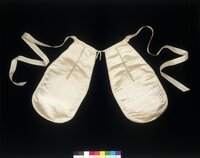
Pair of Pockets. Victoria and Albert Museum. 1760.
Pockets may seem to be a relatively unimportant issue. But the history of who routinely has access to them reveals the significance of pockets as gendered spaces connected to embodied understandings about men and women. Introduced to Britain in the 17th Century, tie-on pockets became wildly popular and widely used by women from all levels of society through the late 19th Century. The impact of tie-on pockets for women was profound. They offered privacy and practicality that empowered women's everyday lives while advancing radical opportunities to subvert traditional expectations and gender roles.
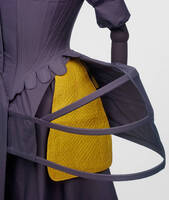
Tie-On Pocket Displayed on a Mannequin. Victoria and Albert Museum, London. 1740.
For men, the empowerment, privacy, and practicality of pockets led to their early integration into men's clothing as sewn-in pockets first appeared in the 16th Century. In contrast, women’s limited legal status and social roles proved central to why pockets remained absent from women’s clothing. In this way pockets in clothing reflected the embodied materiality of people’s lives. The empowerment and privacy sewn-in pockets afforded people did not extend to women. Indeed, society deemed them as unnessary and unsuitable for women. This is why women began to make tie-on pockets at home for their own use.
Worn under dresses and accessed through slits in the outer garment, the use of tie-on pockets died out in the late 19th Century. This was due in part to changing fashions and the narrowing of women’s silhouettes, which consequenlty made it difficult to wear tie-on pockets under dresses. But the significant impact of tie-on pockets and the popularity of designs and designers - often women - incorporating pockets into women’s clothing throughout the 20th Century, continue to reveal how pockets embody social and cultural gender politics. Hence, the lack of functional pockets integrated into women’s clothing has reemerged as a topic of contention in the 21st Century.