"This is our sole political purpose: the safeguarding of the right of the indiviudal to cross dress."
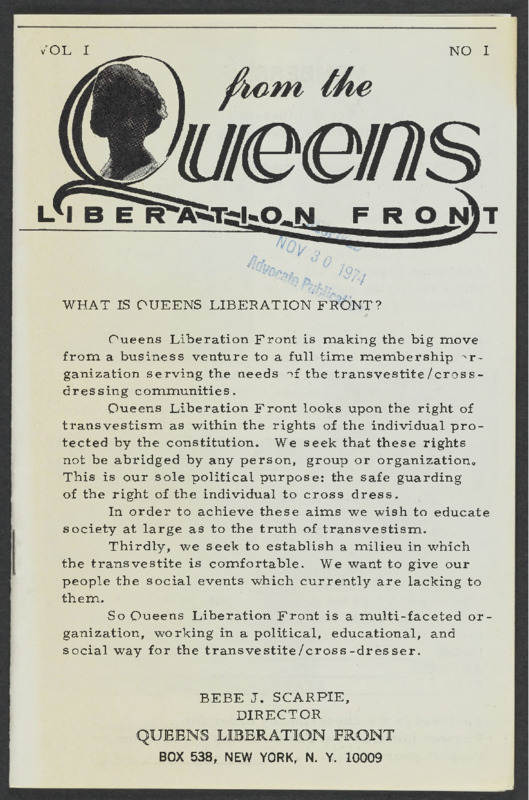
In 1974, the Queen’s Liberation Front posted their first volume, declaring their mission to protect the rights of drag performers and transsexuals. The first page reads, “This is our sole political purpose: the safeguarding of the right of the individual to cross dress." Drag queens and transgender individuals inserted themselves boldly into the conversation, taking up their rightful space in activist communities. The Queen's Liberation Front advocated for their own performances and right to express their gender identity. Drag came back as a strong force used to spread political messages and fight for the rights of all queer people to exist. The QLF was not the only group pushing for the recognition and inclusion of drag queens. Queer focused community events and magazine articles birthed new safe spaces and media for queer individuals to consume.
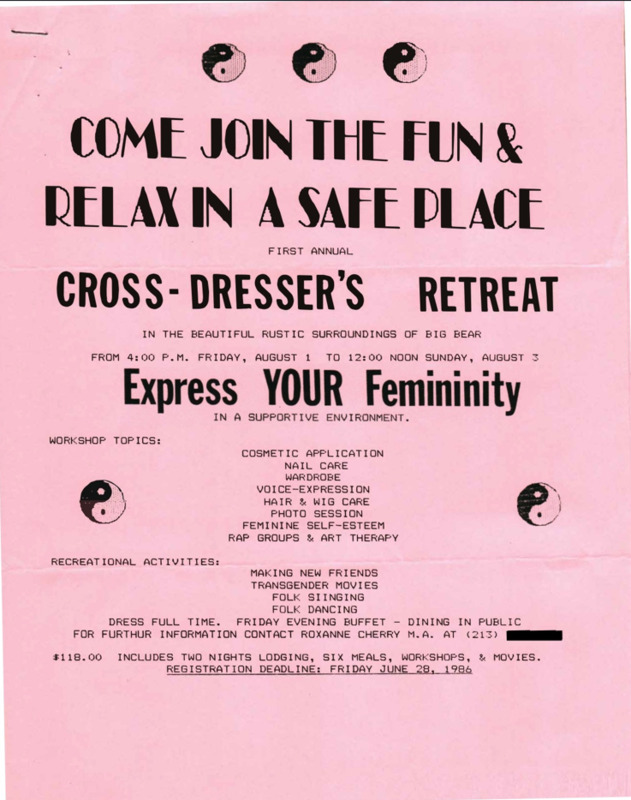
The "Cross-Dresser's Retreat" poster advertises one of these safe spaces. The event, a weekend retreat at Big Bear, includes activities like cosmetic application, voice-expression, nail care, and other traditionally feminine modes of gender expression. The Cross-Dresser's Retreat provided an environment for drag queens, transgender women, and anyone else wishing to experiment with gender expression, the opportunity to meet others in the community and learn about all the ways to transcend their gender. Spaces like these allowed for a wider embrace and acceptance of transgender identities, creating a more inclusive LGBTQ+ rights movement.
"I'm not a female impersonator, they duplicate famous women stars, you know, Channing, Streisand. I'm creating an original."
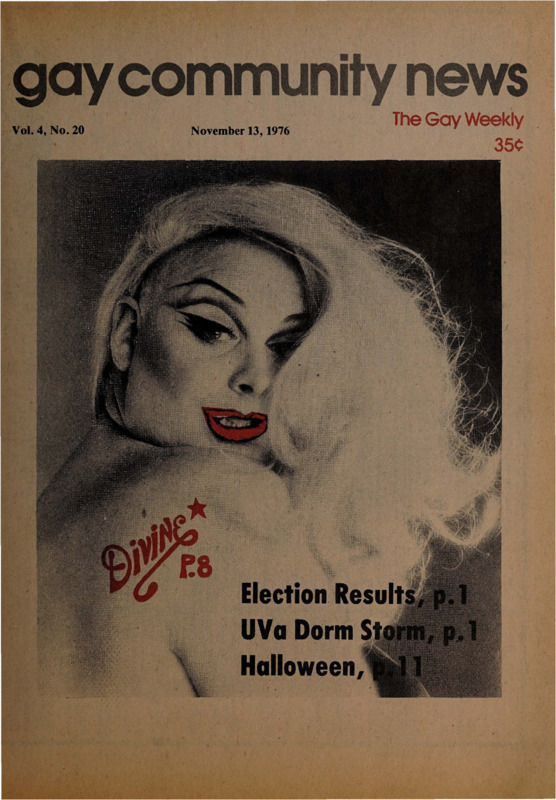
Drag queens, and what they do, became far more common knowledge among the greater queer community. Rather than being a niche for some, it became a safer space for all. Gay Community News, a publication out of Boston, was a source of this knowledge for the LGBTQ+ community. Volume 4, Number 20 of Gay Community News features an interview with drag legend Divine (1945-1988). Before the likes of RuPaul, Divine was mainstreaming drag like never before. Her appearances in films, fashion, and music continue to influence pop stars today. In her interview, she strips down from her wig and makeup to discuss her beginnings, providing a meaningful insight into the real drag world.
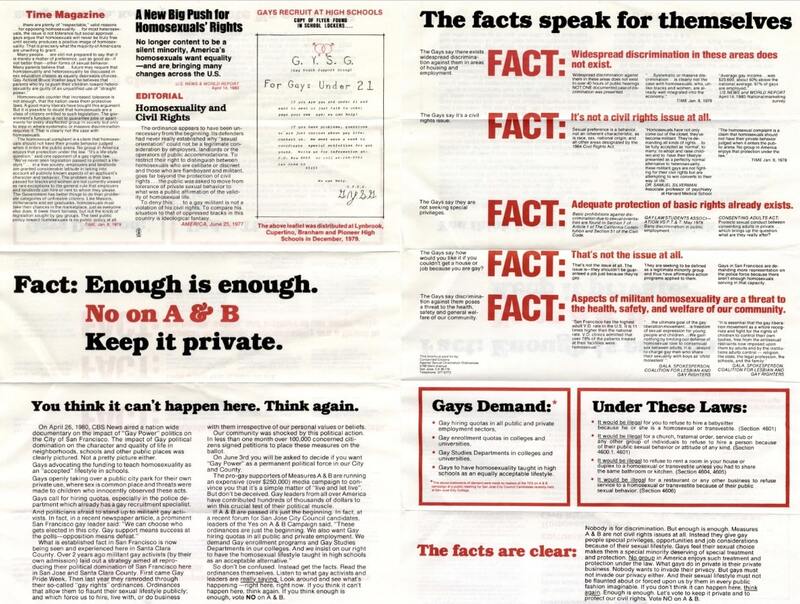
The progress made within the community towards the embracing of drag was met with equal pushback from hate groups and politicians. Specifically, the AIDS crisis forced drag artists to remove themselves from popular culture in the face of rampant discrimination, and take further refuge in queer communities. But it was not just drag queens facing harassment and violence - the LGBTQ+ community was fought against harder than ever. In this poster from 1980, an interest group created a poster to oppose Propositions A and B, which were ballot measures in San Jose and Santa Barbara meant to outlaw discrimination against LGBTQ+ individuals. The poster utilizes harmful rhetoric about gay people, insisting that gay people do not face the discrimination that they claim they do, and their relationships should be kept private. Material like this exemplifies the rampant fight against LGBTQ+ rights activist groups. While the media ignored the tens of thousands of people dying from AIDS, police harassed queer people in the streets. LGBTQ+ people were unable to exist comfortably and without fear. Nevertheless, the brave queer community members banded together, supporting their sick brothers and sisters and continuing to express their radical joy in the face of bigotry.