Madalyn collection/item set
Item set
- Title
- Madalyn collection/item set
Items
-

-
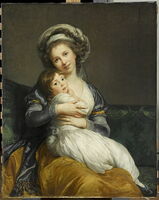 In this portrait of Elisabeth and her daughter, Elisabeth is seated on a couch holding Julie. Elisabeth is positioning her head to be tilted closer to Julie, and exposes a wide smile. Elisabeth's dress has accents of purple and gold with a satin bonnet. While Julie is in a white dress, sitting on her mother's lap.
 -
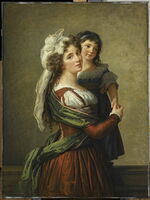 Madame Rousseau is positioned angled, but her gaze is forward. Her right hand is holding her daughter's hand. Her daughter is facing forward, but her gaze follows to the right, alluding to a sense of curiosity. Madame Rousseau is dressed in a red and white dress with a piece of green stretching over her shoulder and tied near her torso.
 -
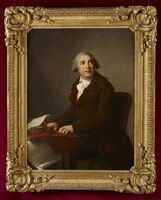 In this portrait Giovanni Paisiello the composer is seated at a red piano. With rolls of compositions on the top of the piano Giovanni is curiously looking upward while playing the piano. He is dressed in a burgundy peacoat with a bright red shirt corresponding to the piano.
 -
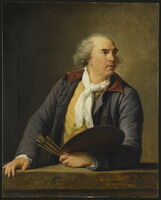 In this portrait the painter Hubert Robert is gazing over a ledge while with a palette and paintbrush in his hand. Hubert was known for his landscapes and architectural paintings. In the painting, due to his leaning gesture, he is interested in the outside world and what is around him.
 -
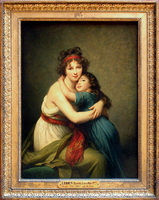 The portrait is depicted in a triangle composition depicting Elisabeth sitting on a bench with her arms wrapped around Julie and her daughter Julie with her arms wrapped around her mother. On the left, Elisabeth is wearing a white cloth that is tied around her with a red scarf around her torso, with an additional green silk draped over her legs. Her hair is tied up with a red ribbon. The attire Elisabeth is wearing evokes ancient Greece and shows insight into her interests. The triangular composition also shows her influence from Raphael and his Madonna and Child. As she was a primarily self-taught artist, this shows how she looked to the masters.
 -
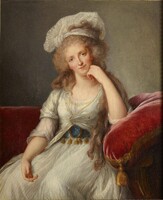 Louise-Marie-Adélaïde de Bourbon-Penthièvre is sitting on a red velvet couch with her elbow on the armrest and her hand holding her chin upward. She is dressed in a white silk and muslin negligee, along with a kerchief on her head. Her expression is longing and melancholic. Representing the norm for portraiture at the time, but also her separation from her children and husband, who were exiled.
 -
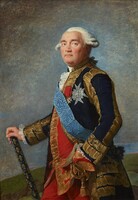 Philippe Henri de Ségur was the Minister of War in France and was appointed Marshall of France in 1783. He is depicted in three-quarter view is standing in the uniform of the Marshal of France. Marquis de Ségur is also dressed in the insignia and sash of the Order of the Holy Cross and the Cross of Saint Louise. He is standing on a small hill with a cloudy sky behind him. Marquis de Ségur is holding the fleur-de-lis staff, representing France's coat of arms, with his other hand in his pocket. He is depicted with a firm expression and stance, portraying his role as the Marshal of France.
 -
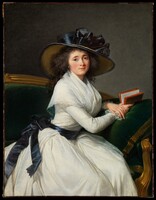 The portrait of Comtesse de la Châtre is dressed in a white muslin dress with a darker blue ribbon tied around her waist. Wearing a wide-brimmed hat with an elegantly tied black ribbon. Châtre is postured slightly turned with her hands crossed on an armrest and her thumb parting a page in a book. The gesture of her hand in the book was commonly used to depict the rise in education of women and the spreading of knowledge through literature.
 -
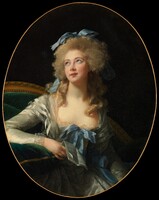 Noël Catherine Vorlée was referred to as Madame Grand. She is depicted wearing a white satin dress with blue ribbon. Madame Grand's hair is tied up with a blue ribbon. She is seated in an armchair with her arm resting and holding a piece of sheet music. Her head is tilted upward with her gaze following. Her lips are slightly parted, alluding to Madame Grand singing.
 -
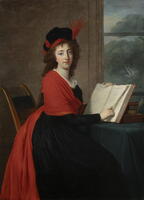 Countess Maria Theresia Czernin is depicted wearing a red shawl along with a black dress. She is wearing a black hat with two red stripes. The Countess has her hair loosely tied back, her expression is lively portraying a slight smile with exposure to her teeth. The Countess is depicted sitting at a desk reading the book "Voyage of Anacharsis." The book was published in 1787-88, it recounts the customs and cultures of ancient Greece. The Countess being depicted reading this books shows the interest in antiquity during this time for the artist and the Countess .
 -
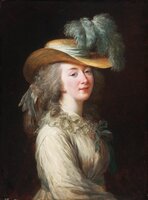 Madame du Barry is depicted in this portrait wearing a straw hat with three feathers. She is wearing a white muslin dress. Her outfit and her expression represents the casualness of the portrait. Madame du Barry was the last mistress to King Louis XV. With the outbreak of the French Revolution Madame du Berry was executed on accusations of helping people escape the French Revolution.
 -
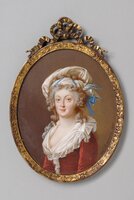 Maria Theresa, the Empress of Austria. Is depicted in the portrait miniature wearing a white bonnet along with a blue ribbon tying it together. She is wearing a red dress with white lace surrounding the neck area. She is turned at a slight angle looking with a slight grin illuminating her elegance.
 -
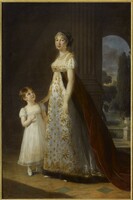 The princess Caroline Murat is depicted as the Grand Dutchess with the titles of Cleves and Berg after her husband campaign in Germany. Caroline is depicted next her her daughter Laetitia. The contrasting gesture Caroline makes to her daughter is gentle and caring for her daughter. Laetitia looks up to her mother in admiration. Caroline is dressed in a white satin dress with gold embroidery as well as a velvet robe. The attire represented shows her relationship with the Empire and the luxuries of the crown. Her daughter is wearing a white dress to match her mother, the two gaze upon with a smile illuminating a gentle atmosphere.
 -
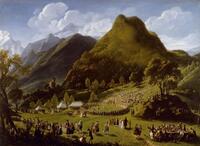 After Elisabeth Louise Vigée Le Brun fled France, she began to travel in Europe. During 1807-1808, she ended up in Switzerland, where she started to create more landscapes. The landscape depicts a Swedish festival that celebrates folklore and customs, called the Swiss Shepherds Festival, taking place in Unspunnen. In the panoramic painting, Elisabeth depicts stone throwing, alphorn concerts, and folk dances. Elisabeth pulls imagery from life and also borrows from the Bernese genre painter Franz Niklaus König.
 -
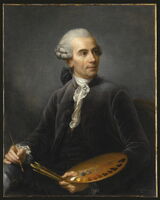 The painter Joseph Vernet is depicted with a raised knee, resting his hand that is holding a paintbrush, while in the other hand he is holding a palette. Joseph's eyes are wide as his gaze travels to the right. Elisabeth knew Joseph through her dad and would often go to him for advice.
 -
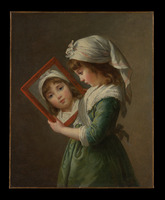 This portrait was a series of three that Elisabeth submitted to the French Royal Academy Salon. Julie is positioned facing to the left, revealing a profile view. She is holding a mirror that reveals a straight-on view of Julie. Playing with illusion draws on two different perspectives in the composition by creating a double image.
 -
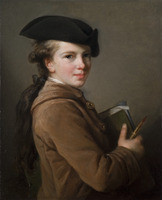 Elisabeth Louise Vigée Le Brun's brother, Étienne Louis Jean-Baptiste Vigée, is a young boy in this portrait. He is wearing a black hat slightly angled, and he is looking over his shoulder. In Étienne's hand, he is holding a sheaf of papers and a pen. Elisabeth portrays her brother's interest in letters and alludes to her brother becoming a celebrated writer.
 -
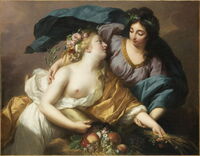 This allegorical painting depicts on the right Peace, who is guiding Abundance with her cornucopia of fruit. Peace is depicted wearing a purple dress with a green shawl, showing its freeing movement, and on her head a crown of leaves. Abundance is depicted wearing a white dress with a gold shawl flowing, and atop her head are flowers. Elisabeth painted this in an effort to attend the Académie royale de peinture et de sculpture as a history painter. During the 1700s, historical, mythological, allegorical, and religious subjects were seen as superior.
 -
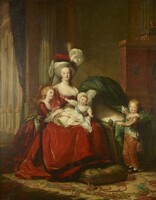 Depicted in this portrait is Marie Antoinette, Louis-Charles of France, known as Louis XVII, Marie Thérèse-Charlotte of France, Duchess of Angoulême, Louis-Josesph-Xavier-François of France, Dauphin, and the empty cradle of Sophie-Béatrice of France. The painting was commissioned to pay homage to King Louis XIV’s grandmother. As Queen Marie Leszczynska was represented in a French-style dress red velvet with trimmed fur. Marie is depicted in a similar fashion in the center of the composition holding her youngest son Louis XVII. Marie Antionette’s expression is bleak showing sorrow. On the left hand side Marie Thérèse is leaning into her mothers arm in a warm embrace. While on the right side Louis-Josesph, (the Dauphin at the time) is by the cradle of Sophie-Béatrice. Sophie-Béatrice had passed away before the painting had finished, portraying this was to gain sympathy from French society. This portrait was also commissioned in an effort to help the public image of Marie Antoinette as a mother figure and to take the light away from her spending habits.
 -
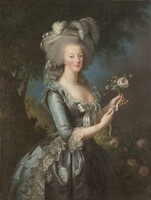 Marie-Antoinette is depicted wearing a blue-gray silk gown and a fabric hat with three feathers. Marie is wearing a pearl necklace with pearl bracelets. She is holding a rose in her left hand, and in her right hand she is holding a ribbon that is wrapped around the rose. The background is naturalistic with a tree on the left-hand side and rose bushes on the right.