Shenai collection
Item set
- Title
- Shenai collection
Items
-
 Image of Shenai Beyale.
 -
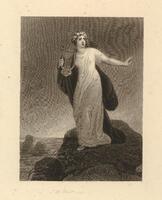 Sappho is in stride to the edge of the cliff she intends to leap off of, relating to the tale/play about her committing suicide after Phaon rejects her. The sea is visible below on the left side. She is in light dress/robes. Dark fabric is draped around her right shoulder and behind her, trailing on the ground. She holds a lyre in her right hand, resting near her upper chest. Her left arm is outstretched behind her in despair as she looks slightly to the left, behind where she intends to leap. Her hair is down, partly behind her shoulders, with a laurel crown atop her head.
 -
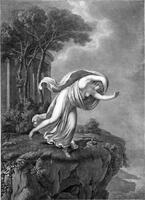 Sappho is mid-leap from the edge of a cliff, connecting to the tale of her suicide after being rejected by Phaon. The sky appears stormy. There are trees and a temple in the background on the left, sitting atop the cliff height. Sappho is draped in fabric similar to a robe with her breasts uncovered and her right leg completely visible up to the side of her waist. Her right arm cradles above her forehead, indicating despair, and her left hand is outstretched as she falls. Part of the sea and shore are visible far below the cliff.
 -
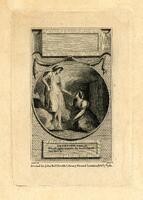 A woman steps toward Sappho, emerging from the left of the illustration, seemingly coming out of a cloud. She extends her left arm down toward Sappho, who kneels and looks up at her. Sappho holds a lyre down toward the floor in her lap with her left arm while her right hand slightly reaches toward the direction of the woman. The woman wears a robe-like dress with her left breast uncovered and her left leg emerging from the fabric. Sappho is in a dress with only portions of her arms and neck uncovered. This is contained in a circular frame with filler decorations, text, drawn fabric, and structures surrounding the frame.
 -
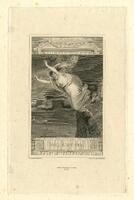 Sappho leaps off of the Leucadian cliff in despair, connected to the play and popular tale of her committing suicide after being rejected by Phaon in their love affair. She is mid-leap from the cliff with her arms outstretched, looking up to the sky with sadness. The sea is visible below in the background with a structure in the distance. Behind her, atop the height of the cliff, part of a building is visible with people crowded outside of it watching her. Some appear to be in distress as they watch the scene. Sappho wears a robe-like dress that does not cover her breasts or arms. A thin piece of fabric unfurls around her right shoulder, waving in the wind above and behind her head as she falls.
 -
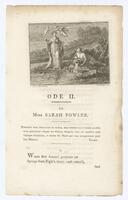 Sappho stands by a river stream in a dress with fabric draped around her shoulders and back. Her left arm is at her side holding a lyre. Her right arm is raised with a writing utensil. Three cherubs float above her. To her left lies a river deity with a vase pouring water into the stream. They lean on the vase, looking up at Sappho. Their upper torso and breasts are exposed with the rest of their body draped by fabric. The river is lined with plants, grass, and trees in the distance. Below this illustration is a page with letterprint writing. Small signatures are directly below the art.
 -
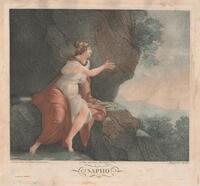 Sappho is depicted sitting on a large rock amidst a rocky landscape near a cliff. She is on the left side of the illustration with her right arm outstretched toward the sky and landscape behind her with trees below it. She wears a white robe-like dress with red fabric draped around her left arm, around her back, and covering her right leg. To the right by her right hand, which rests on the rock she is seated on, is a golden lyre. Below the illustration “SAPHO” is printed.
 -
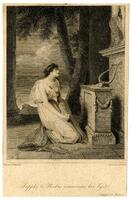 Sappho kneels on the left side of the illustration, facing the right, where an altar stands with a lyre leaning atop it. The sea and trees near the shore can be seen just behind the building in which Sappho kneels, which appears to be open-air. She wears a robe-like dress with a strap that goes between her breasts, leaving them uncovered. Her hair is down, flowing behind her left shoulder, with a headband or laurel adorning the crown of her head. Her hands are clasped as she stares up beyond the height of the lyre on its altar. A long piece of fabric slightly darker than her light garments is draped over her left forearms and around her back atop her feet and ankles. This rectangular illustration is framed by blank space with handwriting on it. Below the art are two signatures on the right and left sides, further below the image “Sappho to Phoebus consecrates her lyre” is written.
 -
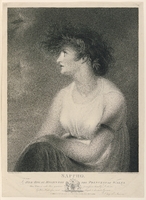 Sappho is depicted waist-up, with her right knee bent so that it fits slightly in frame. She faces the left of the page entirely, her side profile prominent. A laurel adorns the crown of her head. Both the leaves and her hair are visibly flowing in the wind. She wears a dress/robe with her arms uncovered. Her left arm has a jewelry band around the bicep area. Her left forearm rests across her lap, hand covered by her knee. Her right arm is extended by her side and her forearm is obscured by her leg. Behind her is a dark, stormy sky background. Below this illustration is printed text. In big, capital letters, it reads “SAPPHO.” Below that text, it reads “HER ROYAL HIGHNESS THE PRINCESS OF WALES.” With smaller, cursive text below. Between and partly below the words “HIGHNESS” and “THE” is a crest, likely royal.
 -
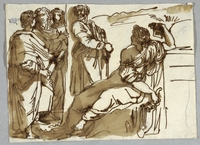 A pen and ink illustration of Sappho with other poets like Petrarch, and a figure nearest Sappho who is believed to be Apollo. Sappho takes up most of the right side of the page, lounging with her legs diagonally toward the bottom left. Three people take up a third of the page on the left, looking and interacting with each other, seeming to come out from behind a wall, all wearing robes with books or other objects in their hands. “Apollo” stands on the other side of the wall, very close to them, though he seems to look over in observance, not interacting with them, just as none of them appear to look at or interact with him either. He holds an object that seems to be an instrument to his left side, away from the three. Sappho rests on a seat, holding an instrument draped toward the ground in her right hand, near the bottom right of the page. Her left elbow rests on a surface at shoulder height, and she appears to hold a book or page with the left hand. She looks back toward the three people. She wears a dress with her left shoulder exposed and a necklace. Her hair is partly pulled back, and likely adorned with a laurel crown.
 -
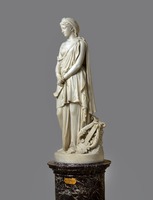 A marble sculpture of Sappho. She is depicted head-to-toe. Her hands are clasped in front of her, a paper in one hand and a writing utensil in the other. Her right knee slightly bent. To the left of her, resting next to her calf, is a lyre with intricate swirling details. She wears a robe that drapes over her left shoulder, the other slouched around her right arm near the elbow, leaving her right breast uncovered. The robe extends to the floor, covering her ankles, with part of her feet visible. She looks slightly down, appearing to be very thoughtful. Her hair is wrapped from the crown to the bottom of her head in a bandana-like cut piece of fabric that keeps her hair pulled back with only some loose strands on her back and shoulders.
 -
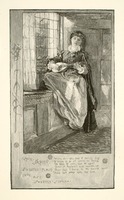 An illustration of Sappho sitting casually in a windowsill with a lute. She is wearing clothing not indicative of her true time period. She wears a dress that appears European and most relevant to the 18th or 19th centuries, with a cape, skirt, frilly neck-hugging collar, and a hat covering her hair that is seemingly pulled up and back. She sits inside of a house in some corner of a room. The borders around the illustration on this page have aesthetic designs filling up empty spaces. Below the art is old English writing. On the left, it describes the scene “Upon Sapho / Sweetly plaie- / inge and / sweetly singing.” with a poem written in smaller print to its right.
 -
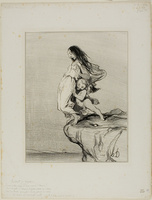 An illustration of Sappho being pushed off of the Leucadian cliff by cupid, connecting to the famous tale and play of her leaping from the cliff of Leucas after her rejection from Phaon in their love affair. The horizon of the sea is visible at the lower portion of the illustration with the cliff’s edge in the bottom right corner. Sappho leans partly back on Cupid as he holds her by the top of her outer thighs and uses his body to push her lower half further. Her hair is down. Rather than a more romantic or aesthetically pleasing style of art she is usually depicted in, her facial features are more jagged, her nose intentionally large and hooked, and her hair is messy. She wears a plain robe that cinches at the waist and only exposes her ankles, feet, and arms. A piece of fabric protrudes from her shoulders behind her hair and waves in the wind. Cupid is bare and his height only reaches below her waist. He appears to have an object hanging behind his back. The illustration is framed by blank space on the paper with handwriting in the bottom right corner, it says: “Sappho’s Death” with “Young ladies, you see where love leads us Under our feet so dainty and small The wretched chasm of an abyss Into which we eventually fall.” below it (translated from French).
 -
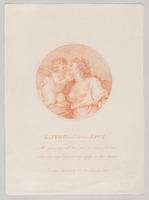 A page with a circular illustration in red ink in the top middle. Within the circle, Sappho is depicted on the right, leaning toward Cupid on the left. Her robes uncover her breasts but cover her arms and the rest of her torso. Her hair appears mostly left down with a crown or headband-like accessory atop the crown of her head. Cupid is naked, his infant form fully portrayed within the circle minus his ankles and feet. Cupid’s right hand grazes Sappho’s jaw, and she cups Cupid’s lower back with her hand. Their faces are very close as they look into each other’s eyes. Below the illustration is “SAPPHO embracing LOVE” in capitalized print (“SAPPHO” and “LOVE”) and lowercase cursive font (“embracing”). Below this is “She gives up all her soul to Loves alarms. / And the sly Tyrant triumphs in her charms.” in cursive print. In smaller cursive print below this is “Dublin Publish’d by Wm. Allen No. 32 Dame Street”.
 -
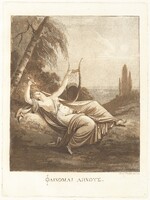 An aquatint illustration in brown with borders on the page. “ΦΑΙΝΟΜΑΙ ΑΠΝΟΥΣ.” is printed under the center of the art with a small signature under the bottom right of the piece. Within the illustration, Sappho is depicted laying across the divot of a hill in distress and “breathless.” She is meant to be overwhelmed with love and passion for Phaon, as the illustration book this comes from is after the tale “La Avventure di Saffo” which chronicles the famous play/tale of her tragic romantic affair with Phaon. On the left of her hip, she balances a lyre, her right arm is raised over her head in distress with a small tool held between her index and thumb. Her robes cover her legs, but not her feet, stomach, breasts, or arms. She appears to have a long fabric veil-like garment draping from her head to her feet. To the left, behind her head, is foliage and a distinct tree reaching to the top of the artwork. To the right, there are tall trees in the more distant background reaching just above the middle of the page. Even further beyond is a faint, flatter landscape.
 -
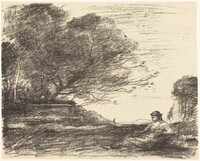 Sappho lounges on the ground near the bottom right, resting on her left elbow as her gaze appears directed toward the ground somewhere near her feet. Her hair is down with what may be a laurel crown on her head, as she is popularly depicted with one. She lies in a nature scene, appearing to be laying on grass or dirt. On the left side of the illustration is a small hill with one large tree with branches extending to the top right, near top middle, and partially into the middle right side of the drawing. Behind this large tree are smaller trees retreating into the background on the far right. On the left, there is a small tree reaching up to the far left middle of the piece. In the distance of the center middle, there appears to be the outline of a mountain far away.
 -
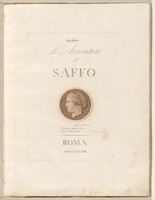 An aquatint title page in brown ink with etchings and engravings. The page itself is slightly brown and sparsely spotted from aging and other unknown forms of tarnishing, but these are all light. The center of the page contains a faint rectangular outline with the title, writing, and illustration within it. John Tresham’s signature is small, above the title “Le Avventure di SAFFO” in large lettering. Below the title is a circular portrait of Sappho that just contains her head and neck. Below this is small cursive writing in Italian with a line drawn underneath it. Below the line is “ROMA” in medium sized print, then “MDCCLXXXIIII” in small print.
 -
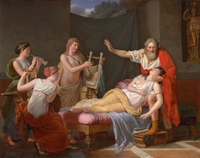 This painting illustrates the melancholy of Sappho upon being abandoned by her lover Phaon, as depicted in the famous tragedies circulating in the eighteenth and nineteenth centuries. The setting is indoors with brown walls and a doorway covered by fabric with the sky and a treetop peeking over the top of the hanging fabric. Sappho lays on a lounge chair with pink cushions and a baby blue blanket in the center right of the piece, wearing white and yellow fabric with her chest partially uncovered. Her head lays back, looking up toward the ceiling, upon the knee of an older man with white and red robes. He has long hair and a beard covering his neck with a golden yellow ribbon in his hair. He cups part of Sappho’s neck as he holds his right hand out toward the three attendants performing music to quell Sappho’s melancholy. His left foot rests on a short wooden stool at her side. A female attendant in white robes sits in a wooden chair at the foot of her bed on the left, playing a golden string instrument. Behind her is a woman in light gray and sage green robes with a double horn instrument. Behind Sappho to the right of the aforementioned woman is a man whose torso is left uncovered with a yellow robe as he plays a lyre.
 -
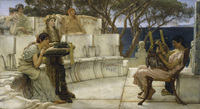 Sappho, the front-most figure on the left, sits in an outdoor theater with other women, watching the poet Alcaeus, the only figure on the right, attentively as he appears to be playing a kithara. Sappho leans on a lectern, atop which rests a laurel crown on a cushion. Alcaeus sits in a large chair with a back that allows him to lean backward as he plays the kithara, sitting below his chair on the right is a small, curved horn instrument. A companion stands to Sappho's left with her arm resting on Sappho's back. Three other women sit in the second/last row of seating watching with them. Greek names are carved into the base of the seating, meant to be that of Sappho's companions/sorority. Behind the tiered seating of the theater, a tall, wide tree peeks out. Behind both the theater and the tree, the sea and sky can be seen.
 -
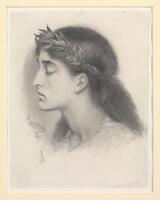 A side profile portrait of Sappho in graphite. A laurel crown decorates her dark, fluffy hair, which is left down, going past her shoulders. Her eyes are gently shut. Behind and surrounding her face and neck is a softly shaded background of light gray that makes the center of the portrait a round, oval-like shape. The rest of the background is left blank. Below her chin and slightly to the left is a small ribbon with "SAPPHO" written in its center. Below that is the artists signature. The edges beyond the paper on which this study is drawn is a yellowed paper background.
 -
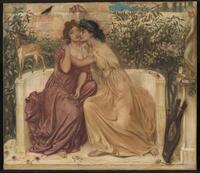 A watercolor scene of Sappho (on the right) embracing Erinna (on the left) seated upon a bench in a garden scene. Sappho is depicted with brunette hair, loosely pulled back and decorated with a laurel on her crown; she is adorned in a creamy golden robe. She turns in her seat upon a bench toward Erinna, embracing her with both arms and her face nudged close to hers with closed eyes. Two doves are seated above the pair on a perch, appearing to 'kiss' their beaks. A young deer stands stop the armrest of the bench on the left side (to Erinna's right). A lyre rests against the base of a statue of a woman beside Sappho's feet on the right (her left). The statue faces both women, her face turned as though she is watching them.