Introduction
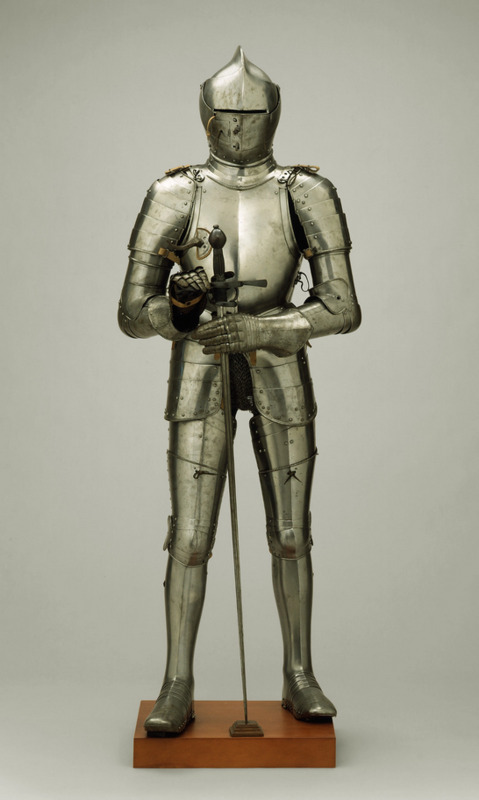
Armor has been a staple throughout history, from mail armor to the reinforced jackets of the military today, being worn for both protection and style. As western Europe developed more advanced weaponry, the full suit of armor too became a reality, with chain mail giving way to plate armor. The development of a full suit of armor, which reached its peak in the late Middle Ages and early Renaissance, could consist of dozens of individual pieces, all coming together to create the now well known image of the knight in a full suit of plate armor. Prior to this, armor would have been more largely available in partial plate armor, which was still produced in the form of munitions armor to protect the lighter infantry soldiers, rather than the full harness used to protect the heavy cavalry.
Throughout Renaissance Europe, several cultures became well known for their craftsmanship of plate armor, with the main centers residing at Milan in Italy, and Augsburg, within the Holy Roman Empire. During this period, full suits of custom-made armor were commissioned by the nobility for the dual purpose of use during tournaments and ceremonies, as well as on the field of battle. The added use during community settings turned armor into an art form unto itself, with armorers crafting highly decorative and ornate suits without risking the durability of the armor.
Armorers worked in a team to craft a suit of armor, either together in one workshop, as was often the case for those who were attached to a royal household in a court workshop, or spread across multiple workshops, as could be the case for those working under an armorers guild. With the advancements made to weaponry and firearms, full suits of armor fell out of favor, and by the seventeenth century, full suits of plate armor became a rarer sight, instead simpler partial suits of armor consisting of mainly just a breastplate were used and worn.
In Renaissance Europe the manufacturing of plate armor was a sophisticated and specialized process that relied on new technological advancements - such as metallurgical innovations and water power - along with a division of labor amongst craftsmen centralized in centers like Milan and Augsburg, transforming plate armor into its own artistic medium, highly decorated and prized by wealthy patrons and nobility.