Decoration Techniques
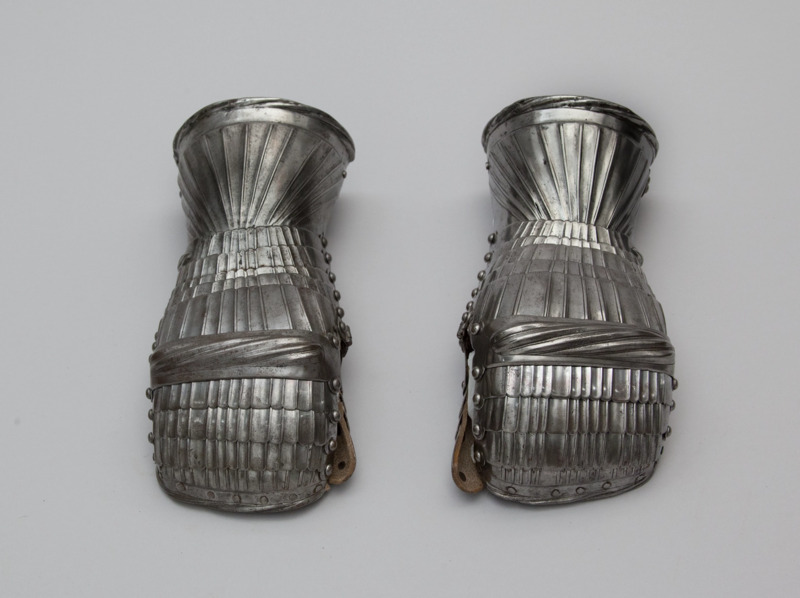
Decorative styles are then added to the armor through a variety of methods. Some, like rolling, are created using smaller hammers and chisels to form the metal into the shape the armorer desires. Rolling is a method often used on the edges of a plate, both to add style and structure, stiffening the plate to avoid warping. The most common way to decorate edges is with simple rolls, although more decorative styles - such as adding a roped decoration through embossing or filing - could be added over top. Fluting and creasing are fairly common ways to decorate armor, and are created in similar ways, with a flute being formed where two concave arcs meet while a crease is formed where two convex arcs meet. Both are crafted in groups, adding to the strength and rigidity of the plate, increasing resistance from attacks. While not found as much on Italian armors, it is used often in the Germanic style, where the emphasis on the vertical is a commonly found design element.
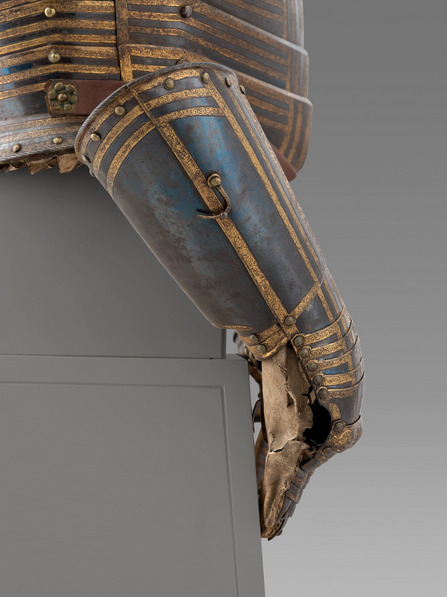

There were several techniques to decorate armor, textiles could be added, or the metal could be colored, gilded, etched, embossed, and so on. These techniques as well served a dual purpose of adorning the armor while also providing a degree of protection from rust and oxidization.
To change the armor color, the metal would be heated to such a degree that when they were removed from the flame at a particular temperature, they would retain their color, ranging from yellow to purple to deep blue as the heat increased. The technique known as "blueing" gets its name from the most commonly chosen color, though this technique was more often applied to weapons than armor.
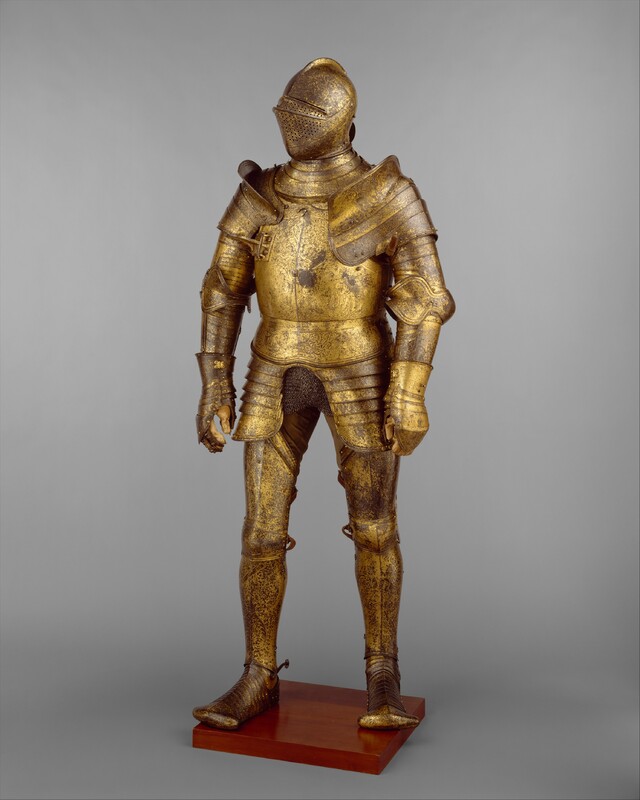
In addition, techniques such as gilding and silvering were used to embellish armor, utilizing several different methods, the most durable of which is "fire-gilding,"where gold is mixed with mercury in an amalgamation to make it hardier before applying it to the armor. The armor would then be heated, metallurgically binding the gold to the surface and removing any excess mercury.
In the later half of the 16th century, the designs would replicate those found within the Ottoman Empire, which used motifs of braided or intersecting lines within the gold - a detail that came to be known as arabesques.
Still there were more ways to decorate armor, such as etching and engraving. Etching is the process where a piece of metal, often protected by wax, is lowered into an acid bath with designs carved out to allow the acid to carve a pattern on the surface. Engraving was one of those processes that would often be outsourced to other craftsmen, with an engraver using small chisels (known as gravers) to cut a pattern into the surface of a plate.