-
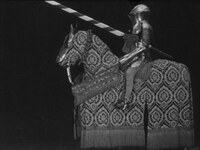 A Visit to the Armor Galleries, 1924 | From the Vaults
 A part of a silent black and white video from the Metropolitan Museum of Art displaying the mobility of a 16th century suit of armor.
-
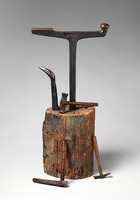 Armorer's Tools
 Armorers tools leaning on and against a shaping stake, set into a wooden base. Two hammers lean against the bottom of the stake, while another lays on the surface next to the stake next to a file.
-
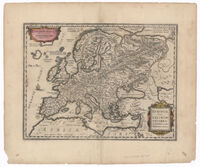 Europam, sive Celticam veterem ; Evropam, sive Celticam veterem
 map of Europe during the 17th century, labeled with latin names.
-
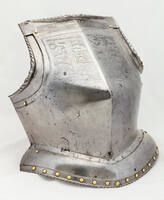 Breastplate
 Steel, of unusual weight, possibly of "proof". Breast elongated, with waistline dipped down towards fork. Medial ridge runs full length, peaking outwardly at about 2/3 of its length. Upper edge of breast nearly parallel, only slightly dipped near extremities. Flexible gussets secured with brass rivets (one modern) & are spring-loaded (cf. however to a similar set on the breastplate of Guidobaldo II delle Rovere, Duke of Urbino, made by Filippo Negroli about 1529. In the Bargello, Florence M772/778, plate 245 in Boccia/Coelho). Edges of gussets & upper edge of breast inwardly rolled, outwardly flared, & boldly cabled with chisel-marks. At mid-point of each is spaced, raised moulding. Right gusset inner edge has been cut away to accomodate bolts of lance-rest, now lacking. Holes are plugged.
Plain, sunken border around armpits & across top of breast, below legend. This reads "CHR[IST]VS MORTVVS EST P[RO]P[TER] PECCATA N[OST]RA/RESURREXIT P[RO]P[TER] IVSTIFICACIONEM N[OST]RI/A + D + E + M + 4 IPH4 + 1557 AE:67".
At base of medial ridge just below waist is "L" shaped bracket which serves to retain leather belt from backplate in position.
5 punched holes on interior of breastplate flange, one at the medial line, one pair each near the terminals, for the leathers of a fauld (lacking). In its place is a single, outwardly curved lame (restored or associated), pierced with two sets of holes for tassets (lacking).
-
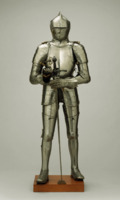 Composite Armor for the Field and Tournament
 Full suit of composite armor holding a longsword. The armor is made of steel with no decorative techniques. There is a lance rest on the left side of the breastplate.
-
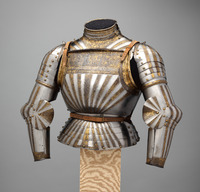 Elements of an Italian Light-Cavalry Armor alla Tedesca (in the German Fashion)
 A half set of Italian armor decorated in the German style of fluting, with gilding laid into the grooves. Its etched and richly gilt decoration is derived from Christian symbolism and the Bible.
-
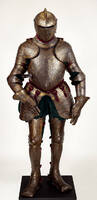 Field Armor from a Garniture
 Close-helmet with 2-piece visor. 1-piece skull, with roped medium comb, and brass plume holder. Restored gorget of 2 halves, pivoting on rivet & secured by stud in keyhole-shaped slot. Breastplate of full-bellied "peascod" shape, dipping slightly below waist. Neck & armpit turns roped & without gussets. Single removable skirt lame. Removable lance rest. Restored backplate of short, broad, rounded form. Single removable loin-guard. Straps at waist & buckles at shoulders. Tassets of 6 lames each. Irregular trapezoidal form, rounded lower lame, low medial ridge. Cuisses of 8 plates each, upper 2 articulated. Attached poleyns with small oval side-wing. Pauldrons lightly asymmetrical, of 7 lames each, rounded in appearance. Full, riveted vambraces with closed cowters. Greaves of open form, hinged on outer face, with buckles & straps. Attached restored sabatons; the greaves were actually designed to be worn with mail foot-coverings. Fingered gauntlets with pointed, flared cuffs. Modern spurs with large, 6-pointed rowels.
The whole of the armor is decorated with etchings that were once gilt, with the cartouches enclose one of three basic motifs: a Medusa head with intertwined serpents; a winged lightning bolt design reminiscent of that found on Roman "scuta"; a downturned barbed trident, mounted by a pair of intertwined dolphins.
-
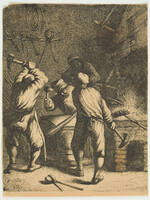 The Forge
 An art piece depicting four armorers working in the forge. Three are gathered around the anvil, working on the hammering stage of the manufacturing process, while the fourth is further back working the bellows.
-
 Right Gauntlet
 A mittened gauntlet for the right hand with a fluted design and articulated lames.
-
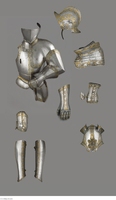 Parts of a Garniture for the Field, Joust and Tourney
 This group of objects comprises portions of a large garniture, with elements for the German joust in the Italian manner, elements for the German joust, and elements for the field. The elements include a reinforcing breastplate, a grandguard, a reinforcing bevor, a manifer for the joust, a burgonet for the field, the left pauldron and gauntlet, greaves, a short cuisse, as well as a demi-shaffron for a horse.
-
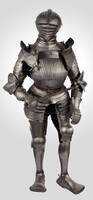 "Maximilian" Field Armor
 Composite, with some restorations. Consists of Armet, Gorget altered from an almain collar, Breastplate with Lance-rest and Tassets, Backplate associated to breastplate, Pauldrons, Arm-Harness, Gauntlets, Cuisses with Poleyns, Greaves with Sabatons (at least partly restored).
-
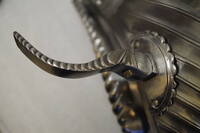 Lance Rest
 Associated. Folds upwards. The entire assembly has been apart; the rest might be composited from separate components.
-
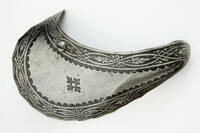 Right-Elbow Reinforce of Armor for Field and Tilt, of Count Franz von Teuffenbach (1516-78)
 Consisting of a single plate with crimped edge, securing with a bolt to the elbow-plate of the vambrace.
-
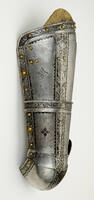 Left Cuisse with Poleyn of Armor for Field and Tilt, of Count Franz von Teuffenbach (1516-78)
 Consisting of upper and lower thighplates, detachable on turning pin, stud, and mushroom stud; 1 lamination above the upper plate; poleyn of kneeplate with 1 lame above, 1 below. Small wing on the kneeplate.
-
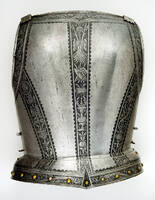 Backplate of Armor for Field and Tilt, of Count Franz von Teuffenbach (1516-78)
 Consisting of mainplate with integral waistflange and a single culet lame. 1554 is etched into the central decorative band, and the initials SR are etched at the top of the shoulder blades.
-
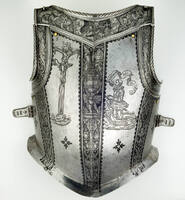 Breastplate of Armor for Field and Tilt, of Count Franz von Teuffenbach (1516-78)
 Consisting of mainplate, bellyplate, waistflange; inset gussets. Secures to backplate with hasps at the shoulders and flanks. Inscribed "FRANZISCKH.V.TEVFNPACH" on frontplate at L shoulder, and "FVDR" (Freiherr von dem Reich?) at corresponding point on R shoulder. The image of the Barbary Order (bearing the legend BARBARIA) is etched into the decorative band on the L side and the date 1554 appears in the central etched band above Teuffenbach's coat of arms.
-
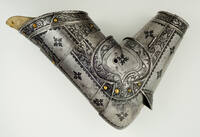 Right Vambrace of Armor for Field and Tilt, of Count Franz von Teuffenbach (1516-78)
 Consisting of turner; upper cannon; cowter of elbow-plate with 1 lame above, 1 below; lower cannon of two hinged halves securing on a stud. The outer plate of the lower cannon has a flaring guard at the elbow. The R vambrace has a hole in the elbow-plate for a reinforce (preserved).
-
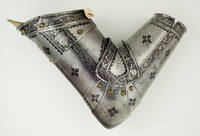 Left Vambrace of Armor for Field and Tilt, of Count Franz von Teuffenbach (1516-78)
 Consisting of turner; upper cannon; cowter of elbow-plate with 1 lame above, 1 below; lower cannon of two hinged halves securing on a stud. The L vambrace has a hole in the elbow-plate for a (lost) reinforce.
-
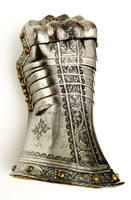 Left Gauntlet of Armor for Field and Tilt, of Count Franz von Teuffenbach (1516-78)
 Consisting of 1-plate cuff; 6 metacarpal lames with knuckle-lame, all overlapping toward the cuff; baseplate for finger lames underlapping the knuckle lame. Fingerlames and thumb defense lacking.
-
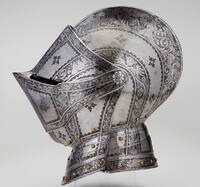 Close Helmet of Armor for Field and Tilt, of Count Franz von Teuffenbach (1516–1578)
 Consists of 1-piece skull with low, sloping comb, with 2 nape lames; visor, upper bevor, and bevor pivoting at ears, with 2 throat lames. Visor secures with a spring-catch on a pullstring; upper bevor secures on a sliding catch; lower bevor secures on sneck-hooks. Upper bevor pierced for a reinforce; lacks breaths.
-
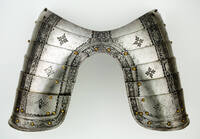 Tassets and Fauld of Armor for Field and Tilt, of Count Franz von Teuffenbach (1516-78)
 Consisting of 2 fauld lames, and 4 tasset lames on each side; all overlapping upward.
-
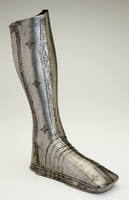 Left Greave and Sabaton of Armor for Field and Tilt, of Count Franz von Teuffenbach (1516-78)
 Consisting of hinged front and rear greave plates, securing on sneck-hooks; sabaton of midplate with 4 lames above, 3 lames and toe-cap above, all overlapping toward the midplate. Greave heels are slotted for spurs.
-
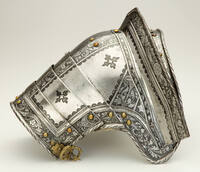 Left Pauldron of Armor for Field and Tilt, of Count Franz von Teuffenbach (1516-78)
 Asymmetric pauldrons consisting of mainlame with 1 lame above, 3 below; fitted for detachable hautepiece that secures on 2 turning pins and a mushroom stud. There is a hole for a reinforce. The armpit flange on the rear of the mainplate has a scalloped edge. Secures with a spring-pin at the shoulder; buckle and strap at the arm.
-
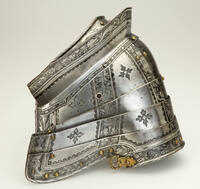 Right Pauldron of Armor for Field and Tilt, of Count Franz von Teuffenbach (1516-78)
 Asymmetric pauldrons consisting of mainlame with 1 lame above, 3 below; fitted for a detachable hautepiece that secures on 2 turning pins and a mushroom stud. The right pauldron is open at the front of the armpit to accommodate a lance. The armpit flange on the rear of the mainplate has a scalloped edge. Secures with a spring-pin at the shoulder; buckle and strap at the arm.
-
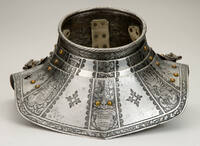 Gorget of Armor for Field and Tilt, of Count Franz von Teuffenbach (1516-78)
 Consists of mainplate with 3 necklames, front and back, with detailed etching